
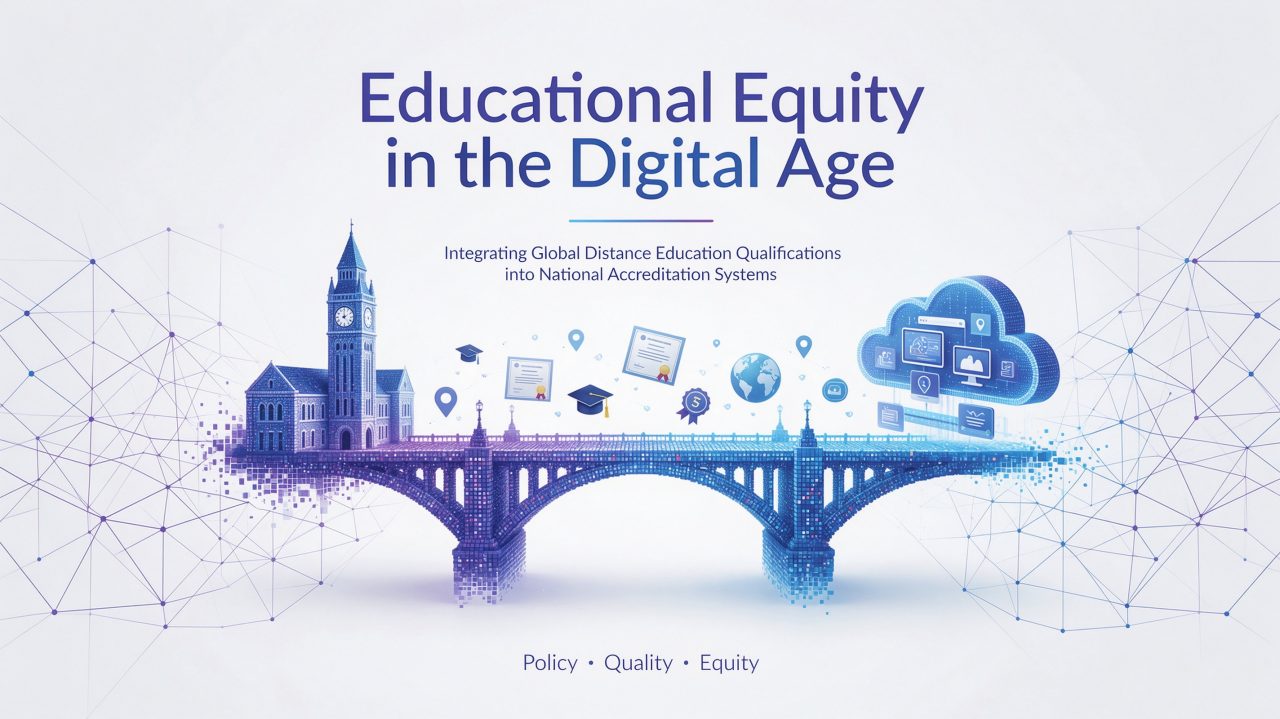
Educational Equity in the Digital Age
Feasibility and Justice Construction for Integrating Global Distance Education Qualifications into National Accreditation Systems
I. Introduction
As digital technologies reshape the global education landscape, distance education has grown from a marginal supplement to traditional schooling into a core pillar of universal higher education and lifelong learning. According to 2024 data from the United Nations Educational, Scientific and Cultural Organization (UNESCO), global higher education enrolment has reached 269 million, doubling the figure from 2000. Non-traditional modes including online degree programs and blended learning have accounted for more than one-third of this expansion. For rural youth in sub-Saharan Africa, working professionals in advanced economies, displaced refugee populations, and students from low-income households unable to afford on-campus study abroad, distance education is dismantling geographic, economic and temporal barriers, opening pathways to higher education for hundreds of millions worldwide.
Yet this explosive growth stands in stark contrast to a global qualification recognition system still rooted in an offline-centric framework. A number of countries exclude formally awarded distance education qualifications from national accreditation systems solely on the basis of delivery mode, and impose blanket non-recognition policies on cross-border online degrees in particular. This accreditation barrier not only violates the fundamental principle of educational equity, but also directly strips ordinary people and low-income groups of their right to upward social mobility through education, emerging as a new source of educational injustice in the digital era.
This paper examines the strategic value of distance education worldwide, explores the underlying rationale of the United Nations and UNESCO in advancing distance learning, and systematically demonstrates the legal basis and practical feasibility of integrating distance education qualifications into unified national accreditation frameworks. It analyses the harm caused by current recognition discrimination to social fairness, and proposes solutions across international rule-making, national governance and social consensus. At its core, this paper advances a fundamental proposition: the value of education lies in learning outcomes and competency development, not in the mode of delivery. To reject qualification recognition on the grounds of online delivery or cross-border status is a de facto restriction on the right to education, and an erosion of social equity and justice.
II. The Global Value of Distance Education: A Shared Cornerstone for Equity, Development and Human Civilization
(1) A Core Vehicle for Educational Equity: Opening Upward Pathways for Vulnerable Groups
Educational equity is the foundation of social justice, and distance education represents the most cost-effective pathway available today to narrow educational gaps globally. Under traditional higher education systems, geographic remoteness, economic poverty, physical disability and family responsibilities constitute insurmountable barriers for countless people. UNESCO statistics show that the gross enrolment ratio in higher education in sub-Saharan Africa stands at only 9%, less than a quarter of the global average. Among the world’s 12.3 million refugees, merely 7% of eligible youth access higher education, compared to the global average of 43%.
With its low cost, high flexibility and borderless reach, distance education holds the key to breaking this deadlock. For low-income populations, distance learning eliminates the heavy costs of campus accommodation, commuting and lost wages from full-time study. Tuition fees typically amount to one-third to one-half of those for on-campus programs, making higher education accessible to households that could never otherwise afford it. For women, persons with disabilities, rural residents and other marginalized groups, distance education removes temporal and spatial constraints, allowing them to complete their studies while fulfilling family and work obligations. In short, distance education is a vital instrument for upholding the universal human right to education, and a powerful driver of global poverty reduction and social mobility.
(2) A Core Engine for Social Development: Human Capital Upgrading for the Digital Economy
As the global economy accelerates its digital and knowledge-based transformation, the labour market faces unprecedented demand for continuous skills updating. Traditional full-time education, with its long cycles, high costs and rigid structure, can no longer meet the needs of the lifelong learning era. With its modular, iterative and on-demand curriculum design, distance education has become the primary channel for workers to upgrade their skills and adapt to industrial transformation.
From a macroeconomic perspective, the recognition of distance education qualifications directly determines whether accumulated human capital can be unlocked. Research indicates that delayed recognition of distance qualifications in Africa alone leaves approximately 17,400 graduates annually trapped in a situation where their qualifications are unacknowledged and their competencies unrewarded, with cumulative GDP losses projected to reach USD 1.3 billion by 2030. Conversely, a well-regulated distance qualification accreditation system would greatly activate the human capital value of existing learners worldwide, drive overall improvement in workforce quality in the digital age, and inject sustained momentum into global economic growth.
(3) An Inclusive Pathway for Human Civilization: Advancing Knowledge Sharing and Cross-Cultural Exchange
Distance education has dissolved the geographic boundaries of knowledge dissemination, allowing high-quality educational resources to flow across nations and cultures. Students in developing countries can pursue courses from the world’s top universities without travelling abroad; learners from diverse civilizational backgrounds can exchange ideas in the same virtual classroom. This universalization of knowledge and mutual learning across cultures marks a major step forward in the progress of human civilization.
The deeper motivation behind the United Nations’ promotion of distance education has never been mere technological diffusion, but a shared commitment to collective human development. Under Sustainable Development Goal 4 (SDG 4) – to ensure inclusive and equitable quality education and promote lifelong learning opportunities for all – distance education is identified as a critical enabler. It carries the civilizational mission of breaking knowledge monopolies, narrowing the North-South divide, and building a global community with a shared future. Its qualifications, by extension, deserve universal recognition across all countries.
III. The Underlying Logic of the International Rule System: Non-Discrimination and Learning Outcomes Orientation
Global recognition of distance education qualifications is not unregulated. The United Nations and UNESCO have already established a complete legal framework and set of guiding principles, centred on quality-based assessment, evidence from learning outcomes, and non-discrimination – fundamentally rejecting the validity of delivery mode as a criterion for accreditation.
(1) The Global Qualifications Convention: Establishing the Legal Status of Distance Education
Adopted by the UNESCO General Conference in 2019 and entering into force in 2023, the Global Convention on the Recognition of Higher Education Qualifications is the first United Nations treaty with global legal force on the mutual recognition of higher education credentials. The Convention explicitly includes “qualifications obtained through distance learning”, “partial study periods” and “prior learning outcomes” within its scope of recognition. It requires contracting states to conduct fair assessments of all higher education qualifications officially recognized by the country of origin, and prohibits discriminatory barriers based on mode of study or delivery format.
The core principle of the Convention is that assessment is based on the knowledge, skills and competencies embodied in a qualification, not on how it was acquired. This means that as long as an institution holds legal authorization to operate and confer degrees in its home country, its qualifications should enjoy equal accreditation status regardless of whether they were earned through full-time on-campus study or online distance learning. Blanket refusal to recognize qualifications solely because they were earned through cross-border distance education runs counter to the non-discrimination principle enshrined in the Convention, and contradicts the direction of international rule-making.
(2) UNESCO Policy Recommendations: Explicit Coverage of Non-Traditional Education
As early as 1993, UNESCO’s Recommendation on the Recognition of Studies and Qualifications in Higher Education stipulated that national qualification assessment procedures “must take into account the diversity of higher education institutions, types of study, curriculum content and teaching methods, including distance education and other non-traditional forms of higher education”. The recommendation further emphasizes that qualifications awarded by foreign institutions should be assessed on an equivalent basis, in line with the legal status they enjoy in their country of origin, and must not be held to a lower standard due to their cross-border nature.
This policy guidance conveys a clear international consensus: differences in learning format cannot justify negating the value of a qualification. The measuring rod of national accreditation systems should be educational quality and learning outcomes, not whether instruction took place in a physical classroom or on a digital platform.
(3) Quality Standards from Professional Bodies: Building a Credible Assessment Framework
Global professional bodies led by the International Council for Open and Distance Education (ICDE) – a non-governmental organization with nearly 60 years of formal consultative relations with UNESCO – have developed mature quality assurance systems for distance education. ICDE’s Quality Review Service (QRS) has become a globally recognized accreditation standard for distance education, covering institutional governance, instructional design, learner support and assessment across the entire educational process. The Tacna Accord, adopted at the 2025 ICDE Policy Forum, lists “fair recognition of open and distance learning qualifications” as one of its eight core principles, calling on all countries to eliminate formal discrimination and build competency-centred accreditation systems.
These international quality standards provide a technically implementable basis for national accreditation of distance education qualifications. Countries do not need to build assessment systems from scratch; they can align with internationally accepted quality accreditation outcomes to achieve scientific and efficient recognition of distance learning credentials.
IV. The Equity Crisis in Current Accreditation Systems: Formal Discrimination and the Violation of Vulnerable Groups’ Rights
Despite clear guidance in international rules, distance education qualification recognition worldwide remains marked by stark national disparities and double standards. The most glaring injustice is the systemic exclusion of international distance education qualifications.
(1) Double Standards: Discriminatory Treatment of Cross-Border Distance Qualifications
Accreditation systems in many countries today exhibit a clear “domestic-foreign divide and form-first” character: distance qualifications awarded by domestic institutions are generally integrated into national qualification frameworks, while foreign distance qualifications of equivalent quality and institutional standing are directly excluded from recognition. Some countries impose blanket non-recognition on all foreign online degrees, citing “cross-border distance delivery” as the sole justification.
This double standard lacks both legal and academic justification. The same degree program from the same foreign institution qualifies for recognition if completed on campus, but is rejected if completed online. Equivalent learning outcomes are treated as fundamentally different merely because of the channel of instruction – a form of status discrimination based on mode of study. Most alarmingly, this discrimination targets only cross-border distance qualifications, effectively restricting learners’ freedom of choice and violating the principle of national treatment in trade in educational services.
(2) The Misconception of Quality: Confusing Delivery Mode with Educational Quality
The most common justification for excluding distance qualifications is the claim that “distance education quality cannot be guaranteed”. This reasoning confuses two entirely separate concepts: institutional quality and mode of delivery. It is true that the distance education sector includes low-quality providers and even diploma mills – but the same is true of offline education. Quality judgements should be applied to individual institutions and programs, not to an entire educational format.
In reality, online degree programs from the world’s top universities maintain identical admissions standards, curriculum rigour and assessment requirements as their on-campus counterparts, and in some cases demand even stronger self-directed learning skills. Distance education qualifications that hold internationally authoritative quality accreditation carry no less academic value than on-campus qualifications of the same level. Judging quality by format rather than substance is a lazy and unfair administrative shortcut.
(3) The Primary Victims: Low-Income and Vulnerable Populations
The cost of accreditation barriers ultimately falls entirely on ordinary learners, especially those from low-income and vulnerable backgrounds. For affluent households, the high cost of overseas study is manageable, and on-campus attendance readily leads to recognized qualifications. For ordinary people with limited financial means, distance learning is often the only viable path to accessing high-quality international education.
Blanket non-recognition policies effectively close off the only channel through which low-income groups can upgrade their qualifications and change their lives via international distance education. After investing time, money and effort to complete their studies, these learners find their achievements unacknowledged simply because they did not physically travel abroad. This is not merely a denial of individual effort; it is a grave injury to educational equity – it turns qualification recognition into a filter for economic capacity, further entrenching class barriers and exacerbating social inequality.
V. Feasibility of Integrating Distance Education Qualifications into National Accreditation
Integrating distance education qualifications into unified national accreditation systems is not only a requirement of fairness and justice, but also rests on solid legal, technical and practical foundations. Its overall feasibility is already well established.
(1) Legal Foundation: Dual Support from International Conventions and Domestic Law
At the international law level, the Global Qualifications Convention and regional qualifications conventions all explicitly cover distance learning credentials, and contracting states bear treaty obligations to implement non-discriminatory recognition. As of 2026, the Global Convention has 42 contracting states, covering more than half of the world’s higher education students, and a multilateral recognition network is taking shape. Integrating distance qualifications into national accreditation systems is essentially the fulfilment of international treaty obligations, not an institutional breakthrough.
At the domestic law level, the higher education legislation of most countries does not make in-person attendance a prerequisite for the legal validity of degrees. Distance education degrees lawfully awarded by accredited institutions carry full legal effect in their country of origin, and by the principle of reciprocity, deserve equivalent recognition in receiving countries. Current exclusion policies are more a product of administrative inertia than binding legal constraints, leaving ample room for policy adjustment and improvement.
(2) Technical Foundation: Verifiable Quality and Comparable Outcomes
Digital development has fundamentally resolved the verification and assessment challenges of distance education qualifications. On the quality assurance front, internationally unified quality accreditation systems for distance education are maturing. Accreditation outcomes from bodies such as ICDE and Quality Matters enjoy broad credibility and can serve as a precondition for national recognition, enabling “one assessment, acceptance worldwide”.
On the verification front, blockchain technology makes distance education degrees and academic transcripts tamper-proof and globally traceable, eliminating diploma fraud. Artificial intelligence-powered course matching systems can rapidly conduct learning outcomes equivalence assessments across institutions, greatly reducing administrative costs and technical thresholds for accreditation. Technical barriers have been largely removed.
(3) Practical Foundation: Mature Paradigms Already in Place Worldwide
A large number of countries and regions have already taken the lead, providing replicable practical experience for distance qualification accreditation. In Europe, under the Bologna Process, the European Credit Transfer and Accumulation System (ECTS) applies fully to online learning programs; online credits enjoy the same transfer value as offline credits, and distance education qualifications can be used without restriction for further study and employment. In the United States, the six regional accreditation agencies cover online and offline programs uniformly, and accredited online degrees hold exactly the same legal status and social recognition as full-time on-campus degrees. In India, education authorities explicitly include online and distance learning qualifications in the national qualifications framework, treating them equally with traditional credentials.
Experience in these countries demonstrates that integrating distance qualifications into national accreditation does not lead to quality chaos. Instead, it makes education systems more inclusive and dynamic, with fully manageable risks and highly significant benefits.
VI. Pathways to Advancing National Accreditation of Distance Education Qualifications Globally
Building a fair and well-regulated distance qualification accreditation system requires coordinated efforts from international organizations, national governments, educational institutions and all sectors of society. The core task is to return to a learning outcomes orientation, eliminate formal discrimination, and achieve equal standards and equal recognition.
(1) At the International Level: Strengthen Convention Implementation and Unify Regulatory Standards
First, promote the full implementation of the UNESCO Global Qualifications Convention, and urge contracting states to incorporate distance qualification recognition into domestic implementing regulations, explicitly prohibiting discriminatory thresholds based on mode of study or cross-border status. Under UNESCO’s leadership, a Practical Guide to Distance Education Qualification Recognition should be developed to unify assessment standards and operational procedures, and provide normative guidance for all countries.
Second, establish a multilateral mutual recognition mechanism for global distance education quality accreditation. Leveraging international bodies such as the International Network for Quality Assurance Agencies in Higher Education (INQAAHE) and ICDE, promote mutual acceptance of accreditation outcomes across national agencies, so that legitimate distance qualifications can be assessed once and accepted globally – removing the root cause of duplicate evaluation and trust barriers.
(2) At the National Level: Unify Accreditation Rules and Eliminate Double Standards
First, enshrine the accreditation principle of “quality first, form neutral”. Countries should revise their qualification recognition policies to clarify that domestic and international distance education qualifications are subject to the same assessment criteria, judged on the basis of institutional status, program quality and learning outcomes. “In-person contact hours” or “physical travel records” must not be made preconditions for accreditation. Foreign distance education qualifications that hold internationally recognized quality accreditation should be recognized directly.
Second, establish a tiered and targeted accreditation mechanism. Abandon the blanket one-size-fits-all model, and conduct graded assessment based on institutional qualification and program quality: high-quality distance programs from officially accredited institutions that have passed international quality review receive full qualification recognition; regular legitimate distance programs receive corresponding recognition after course equivalence assessment; and providers identified as low-quality or diploma mills are placed on a negative list and rejected.
Third, strengthen supervision and risk prevention in parallel. Enhance information sharing with international organizations and education authorities of source countries, establish verification channels for foreign distance education institutional qualifications, crack down on fake degrees and diploma mills, and safeguard the credibility of the accreditation system while upholding fairness.
(3) At the Social Level: Reshape Talent Evaluation Concepts and Abandon Formalism
Encourage employers to adopt competency-centred talent evaluation systems, and abandon formalistic hiring criteria that prioritize only full-time on-campus credentials. Guide society to recognize that the essence of education is competency improvement, and that mode of study is merely a vehicle for knowledge transmission. In the digital economy, the ability to learn remotely is itself a core component of digital literacy. The self-directed learning and time management skills demonstrated by distance education graduates are precisely the qualities valued in the workplace.
VII. Conclusion
The rise of distance education is a gift of the digital age to all humanity. For the first time, education has a real chance to transcend mountains and oceans, bridge gaps between rich and poor, and grant every person who thirsts for knowledge an equal chance to advance. Qualification recognition is the final mile that turns this promise into reality.
To refuse recognition on the basis of learning format is to block more than just a diploma – it is to shut down the hope of a better life for countless ordinary people. To treat international distance qualifications differently is to harm more than just individual rights – it is to undermine the bottom line of educational equity and the inclusive aspiration of human civilization. Educational equity is not a slogan; it is embodied in respect for every learning path, in acknowledgement of every effort made, and in the fair treatment of every person’s qualifications under the same standard, regardless of wealth or location.
Promoting the full integration of distance education qualifications into national accreditation systems, and granting international distance qualifications the same legal status as domestic and full-time qualifications, is both a natural corollary of implementing international conventions and an inevitable requirement for advancing educational equity. It is also the historical tide of progress for human civilization. There is every reason to believe that when formal barriers are broken and the value of ability is affirmed, education will truly become a light illuminating the path of every individua