
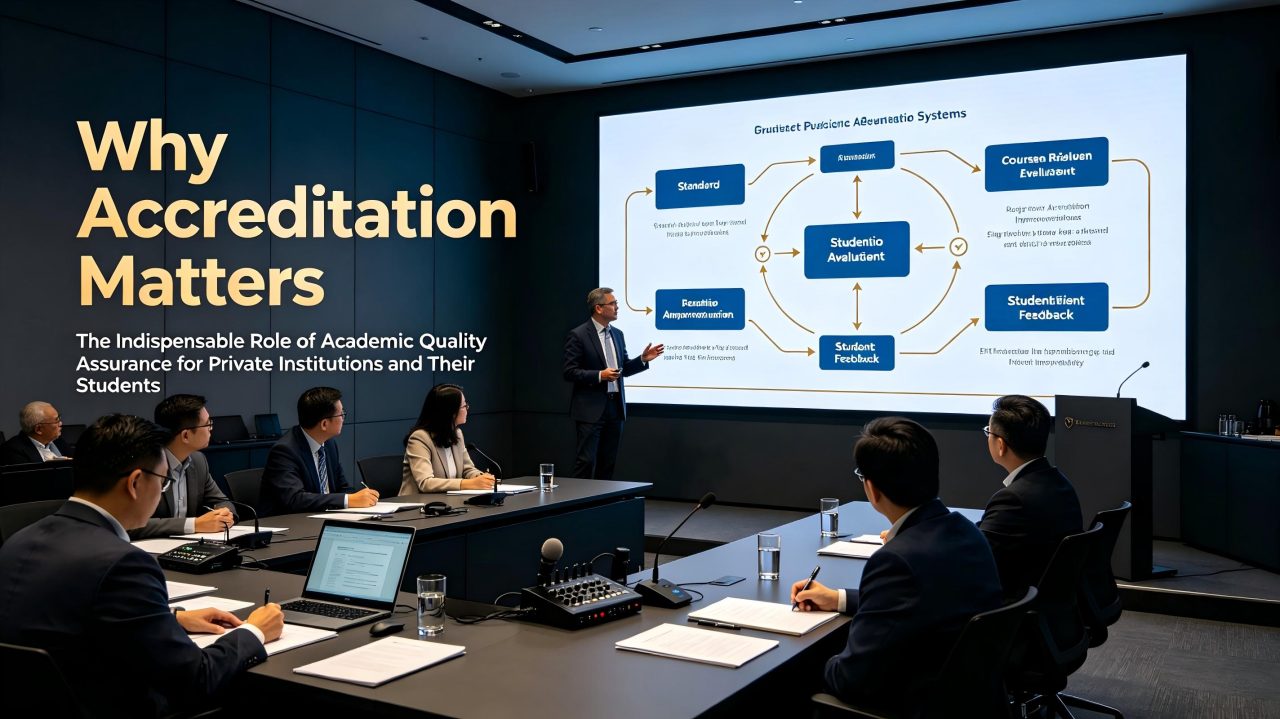
Why Accreditation Matters
The Indispensable Role of Academic Quality Assurance for Private Institutions and Their Students
In an era of unprecedented global expansion in private higher education, the question of quality has never been more urgent. Between 2000 and 2020, the share of students enrolled in private institutions worldwide increased from 19 percent to over 33 percent, with growth accelerating across Asia, Africa, and Latin America. Yet this remarkable expansion has been shadowed by a persistent challenge: how can students, employers, and the public distinguish genuine educational quality from its appearance?
Accreditation provides the answer. As the Council for Higher Education Accreditation (CHEA) observes, accreditation is “the primary means of assuring the public that colleges, universities and programs can and do provide students with a quality education.” It is, at its core, a signal that an institution has been vetted by an independent authority and meets recognized standards of quality. For private institutions—which often lack the centuries of accumulated reputation that public universities enjoy—accreditation is not merely beneficial; it is essential.
I. What Accreditation Is—And What It Is Not
Accreditation is a formal process of external quality review. An independent accrediting body evaluates an institution or program against defined standards through a rigorous process that typically includes institutional self-study, peer review, and on-site evaluation. It is not a one-time stamp of approval but a continuing commitment. Accredited institutions undergo periodic re-evaluation, ensuring that quality is not a static achievement but a dynamic process of continuous improvement.
For private institutions, accreditation serves three fundamental functions.
First, it provides external validation. Accreditation confirms that an institution meets threshold standards of quality in curriculum, faculty qualifications, student support, and institutional resources. It tells students, employers, and the public that the institution has been examined by experts and found credible.
Second, it drives internal improvement. The self-study required for accreditation—a comprehensive review of institutional performance against established standards—is itself a powerful tool for institutional reflection and growth. It forces institutions to ask difficult questions: Are we achieving what we claim to achieve? Where are our weaknesses? How can we improve?
Third, it creates accountability. Accreditation subjects institutions to ongoing scrutiny. Accredited institutions must demonstrate continuous improvement, submit regular reports, and undergo periodic re-evaluation. This accountability protects students and the public from institutions that fail to deliver on their promises.
II. Why Accreditation Matters for Private Institutions
Private institutions face distinctive challenges that make accreditation particularly critical.
A. Building Credibility in a Competitive Market
Private institutions operate in a marketplace where reputation is currency. Unlike public universities, which often enjoy presumptive legitimacy, private institutions must actively prove their quality. Accreditation provides that proof. Research on Russian private universities found that private institutions face a “legitimacy deficit”—they are more likely to undergo inspection than public institutions, even after controlling for performance indicators. Accreditation helps close this gap by providing an independent, credible signal of quality.
For emerging private institutions, accreditation is often the fastest route to establishing credibility. For established institutions, maintaining accreditation signals an ongoing commitment to quality that distinguishes them from competitors.
B. Driving Institutional Quality and Continuous Improvement
Accreditation transforms quality from an aspiration into a disciplined practice. The accreditation process requires institutions to define their missions, articulate their goals, measure their performance, and demonstrate improvement. This is not a compliance exercise; it is a systematic approach to institutional development.
Research confirms the transformative potential of accreditation. A study of a private business school in Kazakhstan found that leadership viewed international accreditation as “a way to enhance international visibility and a tool for self-evaluation,” while faculty acknowledged improvements in the curriculum. Although faculty sometimes perceived accreditation as an administrative burden, the process nonetheless generated meaningful curriculum enhancements.
Accreditation also drives attention to student learning outcomes. As the Southern Association of Colleges and Schools Commission on Colleges (SACSCOC) reaffirmed, “accreditation plays a critical role in ensuring both accountability and continuous improvement across higher education,” with particular emphasis on “outcomes, assessment, and institutional effectiveness.”
C. Enhancing Faculty Development and Research Capacity
Accreditation standards typically require institutions to demonstrate faculty qualifications, professional development, and research activity. This creates institutional incentives to invest in faculty development. Research has shown that faculty who have achieved accreditation recognition demonstrate “significantly more effective teaching practices” and “stronger teaching outcomes” than their non-accredited peers.
For private institutions with limited resources, accreditation provides a framework for prioritizing faculty development and research support. It establishes benchmarks that guide resource allocation and strategic planning.
III. Why Accreditation Matters for Students
For students, accreditation is not an abstract institutional concern. It has direct, tangible consequences for their educational experience, their career prospects, and their financial well-being.
A. Degree Recognition and Employability
Perhaps the most immediate benefit of accreditation for students is that it makes their degrees recognizable. As the New England Commission of Higher Education (NECHE) explains, “Many employers and graduate programs require a degree from an accredited institution.” An accredited credential signals to employers that the graduate has met minimum standards of quality and has demonstrated the skills and abilities required by accreditation standards.
The consequences of attending an unaccredited institution can be devastating. In Ghana, over 3,500 students from 22 unaccredited institutions were disqualified from national service, lost student loan benefits, and faced rejection of their qualifications by employers and postgraduate institutions. As the South African Qualifications Authority warned, learners who enroll in unregistered institutions face “serious risks, including the loss of time and money, qualifications that are not recognised by employers … and limited or no opportunities for further study or career progression.”
B. Access to Financial Aid
Accreditation is often a prerequisite for access to financial aid. In the United States, “Federal financial aid is generally available only to students at schools accredited by a recognized agency.” Similarly, state governments monitor accreditation status when determining how to distribute state aid. For many students, this access is the difference between being able to afford higher education and being excluded from it.
C. Credit Transfer and Academic Mobility
Students change institutions for many reasons—financial constraints, family circumstances, academic interests, or geographic relocation. Accreditation determines whether their credits will follow them. Credits earned from non-accredited institutions “may not transfer to other postsecondary institutions.” Students of accredited institutions, by contrast, “have a greater chance of having their credits transfer to other accredited institutions.”
This has profound implications for student mobility and educational opportunity. Accreditation enables students to move between institutions without losing the investment they have made in their education.
D. Professional Licensure and Career Advancement
In many professions, accreditation is a prerequisite for licensure. States “may not recognize credits from a non-accredited institution and may not allow graduates of non-accredited institutions to sit for professional licensure exams.” For students pursuing careers in engineering, nursing, teaching, law, or business, this can be a decisive barrier.
E. Academic Motivation and Performance
The benefits of accreditation extend beyond external recognition to the student experience itself. Research on private business schools found that “students’ knowledge of the value of accreditation has a 60% higher impact on their overall performance than their awareness of the program’s or college’s strategic objectives.” In other words, when students understand that their education is accredited and valued, they perform better. Their awareness of accreditation’s significance translates directly into academic motivation and achievement.
IV. Accreditation and Curriculum Quality
Accreditation shapes curriculum in ways that directly benefit students. The process requires institutions to define learning outcomes, align curriculum with those outcomes, assess student achievement, and use assessment results for improvement. This “outcomes-based” approach ensures that curriculum is not merely a collection of courses but a coherent pathway to demonstrable learning.
Accreditation standards also keep curriculum current. Accrediting bodies periodically re-evaluate and modify their standards to “address changes in the technical, social, and economical environment.” This ensures that accredited programs remain relevant to evolving professional and societal needs.
For private institutions, which often have greater flexibility in curriculum design than public institutions, accreditation provides a framework that ensures flexibility does not become a license for quality compromises. It sets minimum standards while allowing institutions to innovate within those standards.
V. Accreditation and Teaching Quality
Accreditation directly influences teaching quality through its requirements for faculty qualifications, teaching effectiveness, and student support. Accredited institutions must demonstrate that their faculty members are appropriately qualified, that teaching is regularly evaluated, and that students receive adequate academic support.
The peer review process central to accreditation—in which faculty and administrators from other institutions evaluate programs—brings external expertise and fresh perspectives to teaching quality. It provides institutions with feedback that is both credible and constructive.
Research has demonstrated that accreditation frameworks significantly enhance teaching effectiveness. Studies of faculty development programs linked to accreditation have found that accredited faculty demonstrate “significantly more effective teaching practices” and that students report enhanced learning outcomes.
VI. Accreditation and Research
For private institutions that aspire to research activity, accreditation provides both incentive and framework. Accreditation standards typically require evidence of scholarly activity, research infrastructure, and faculty research qualifications. This encourages institutions to invest in research capacity and to create conditions that support faculty research.
Accreditation also enhances the credibility of research produced by private institutions. Research conducted at accredited institutions is more likely to be recognized by peers, published in reputable venues, and valued by funding agencies. This recognition, in turn, supports the recruitment of research-active faculty and the development of research programmes.
VII. The IAPUC-IQA Framework: A New Standard for Private Institutions
The IAPUC Internal Quality Assurance (IQA) framework represents a significant advancement in accreditation for private institutions. Built on three pillars—Mission-Driven, Outcomes-Based, and Performance Excellence—the IQA framework is the world’s first comprehensive accreditation system designed specifically for private universities and colleges.
Unlike accreditation systems developed primarily for public institutions or limited to specific disciplines, the IQA framework is tailored to the distinctive characteristics of private higher education: mission diversity, governance flexibility, resource variability, and market responsiveness. It evaluates institutions against their own missions rather than against a one-size-fits-all template, asking not whether an institution resembles a public university but whether it achieves what it sets out to achieve.
This approach does not lower standards; it makes them more relevant. An institution that defines its mission clearly, measures its outcomes rigorously, and demonstrates continuous improvement earns IQA accreditation regardless of its size, location, or disciplinary focus.
The IQA framework also addresses the specific challenges private institutions face in the accreditation process: financial constraints that make accreditation costly, institutional newness that makes demonstrating quality difficult, and regulatory environments that may not recognize international accreditation. By providing a clear, accessible pathway to accreditation, the IQA framework helps private institutions overcome these barriers.
VIII. The Consequences of Non-Accreditation
The risks of operating without accreditation are substantial and growing. As regulatory oversight of higher education intensifies worldwide, unaccredited institutions face increasing scrutiny and sanction. Students who enroll in unaccredited institutions risk losing their educational investment, their career prospects, and their financial aid.
The Ghana case is instructive. When the Ghana Tertiary Education Commission cracked down on unaccredited institutions, over 3,500 students found their qualifications at risk of being declared invalid. These students had invested years of study and significant financial resources, only to discover that their degrees might be worthless.
This pattern repeats across the world. In Malawi, the National Council for Higher Education warned that “no student should graduate from an unaccredited course.” In South Africa, authorities urged students to verify institutional registration before enrolling, warning that unregistered institutions offer qualifications “not recognised by employers.”
For private institutions, non-accreditation is not merely a regulatory problem; it is a business problem. Students increasingly research accreditation status before enrolling. Employers increasingly verify institutional credentials before hiring. The market is becoming more discerning, and institutions without accreditation are being left behind.
IX. Conclusion
Accreditation matters because quality matters. It matters to students, who deserve an education that will serve them throughout their lives. It matters to employers, who need reliable signals of graduate competence. It matters to societies, which depend on higher education to develop human capital and drive economic growth. And it matters to private institutions themselves, which need accreditation to build credibility, drive improvement, and compete effectively.
For private institutions, the case for accreditation is particularly compelling. Accreditation provides the external validation that private institutions often lack, the framework for continuous improvement that drives institutional development, and the credibility that attracts students, faculty, and partners.
For students, accreditation provides the assurance that their educational investment is secure, their credentials will be recognized, and their career prospects will be enhanced. It protects them from the devastating consequences of enrolling in unaccredited institutions and provides them with the opportunities that come from a recognized, respected education.
The IAPUC-IQA framework represents a new chapter in this story—one in which private institutions have a clear, accessible pathway to accreditation that respects their distinctive missions while ensuring rigorous quality standards. For private institutions and their students, this is not just an option; it is an imperative.