3000 Huron St, Unit 650, Denver, CO 80202
+1 (720) 897-8865

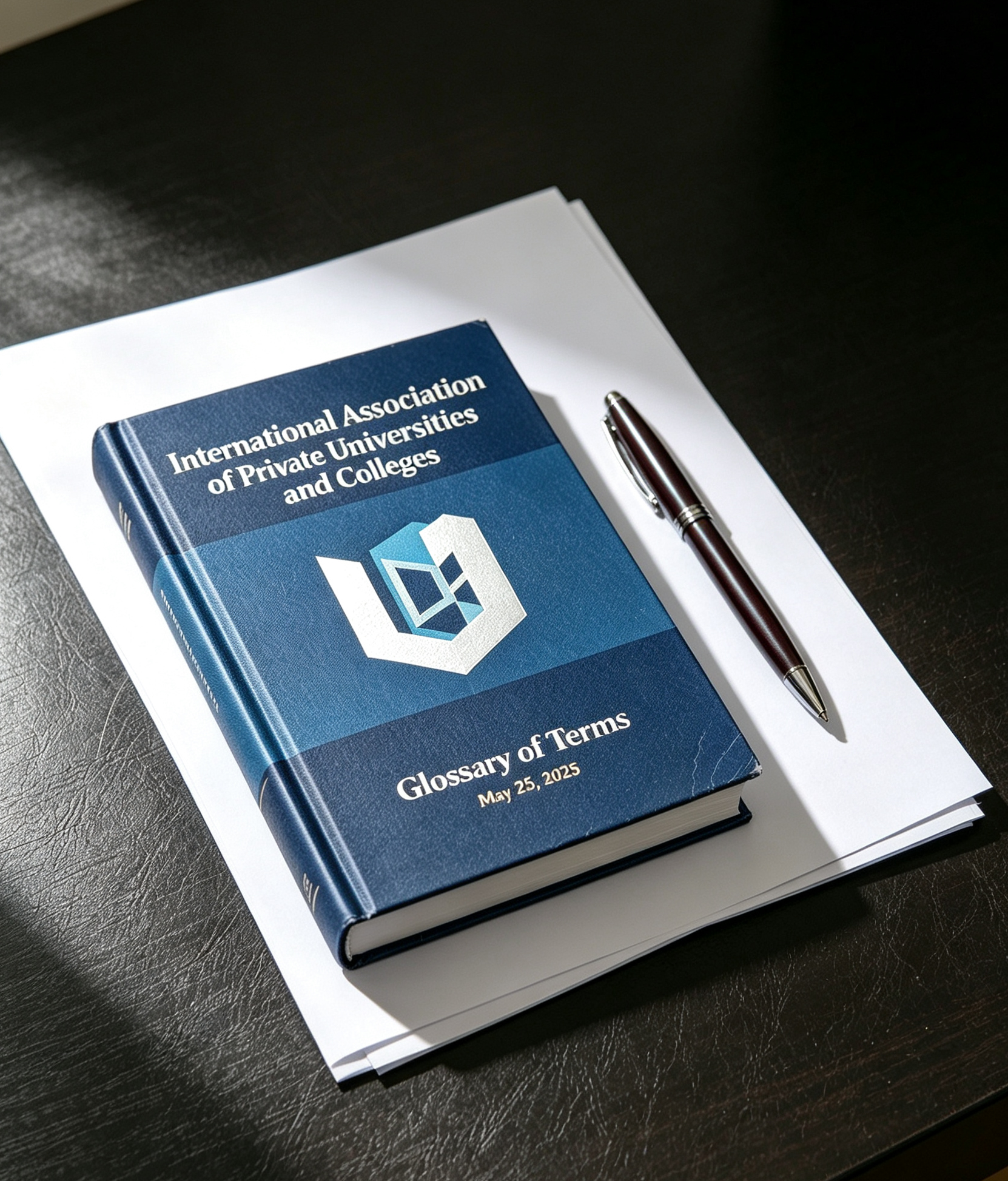
This Glossary unifies IAPUC-IQA terms to strengthen standardized governance and institutional quality assurance.
IAPUC manages rules on governance codes, bylaws, IQA audits and cross-border education. Different term interpretations create confusion among staff, assessors and member schools; this benchmark removes ambiguity and ensures fair, identical standards for board work, compliance and quality checks.
For global private higher education partners, IAPUC delivers cross-border cooperation, multilingual accreditation and international outreach. Unified terms serve as a translation baseline to avoid meaning distortion, keeping consistent rigour as we share our governance and quality standards worldwide.
Terminology alignment underpins the IQA system. Short consistent definitions support quality evaluation, institutional inspection and ongoing improvement, providing objective yardsticks to judge institutional excellence.
As the top interpretative reference for all IAPUC official documents, this Glossary defines steps to review, add and revise terms. It allows traceable comparison of old and updated policies, forming a self-renewing closed regulatory framework to boost governance efficiency.
Consistent terms align governance logic, standardize quality measurement and regularize global communication. It is an essential institutional pillar enabling IAPUC to advance excellence in global private higher education via strict, transparent governance norms.
* This glossary is compiled to unify terminological standards across the full IAPUC-IQA system. It eliminates conceptual discrepancies in governance documents, assessment materials and global outreach files, laying a consistent foundational benchmark for standardized institutional governance and quality assurance.
This document supplies standardized term translations covering ten official languages: English, Chinese, Japanese, Korean, French, German, Spanish, Italian, Russian and Arabic, to facilitate cross-border multilingual cooperation and accreditation work worldwide.
The English version shall prevail as the authoritative standard. Chinese serves as the secondary reference language. All other translated language versions are provided solely for auxiliary consultation and shall not supersede the original English text in official use.

The International Association of Private Universities and Colleges (IAPUC), a global authoritative non-profit industry organization serving private higher education institutions worldwide, devotes itself to quality accreditation, standard development, academic exchanges and international advancement of private universities, colleges and private higher vocational colleges.
United through sincere collaboration, rooted in professional proficiency, guided by global vision to perceive trends, and sustained by steadfast perseverance amid shifts, we help private universities and colleges address emerging challenges and disruptive transformations with composure.

You cannot copy content of this page
