
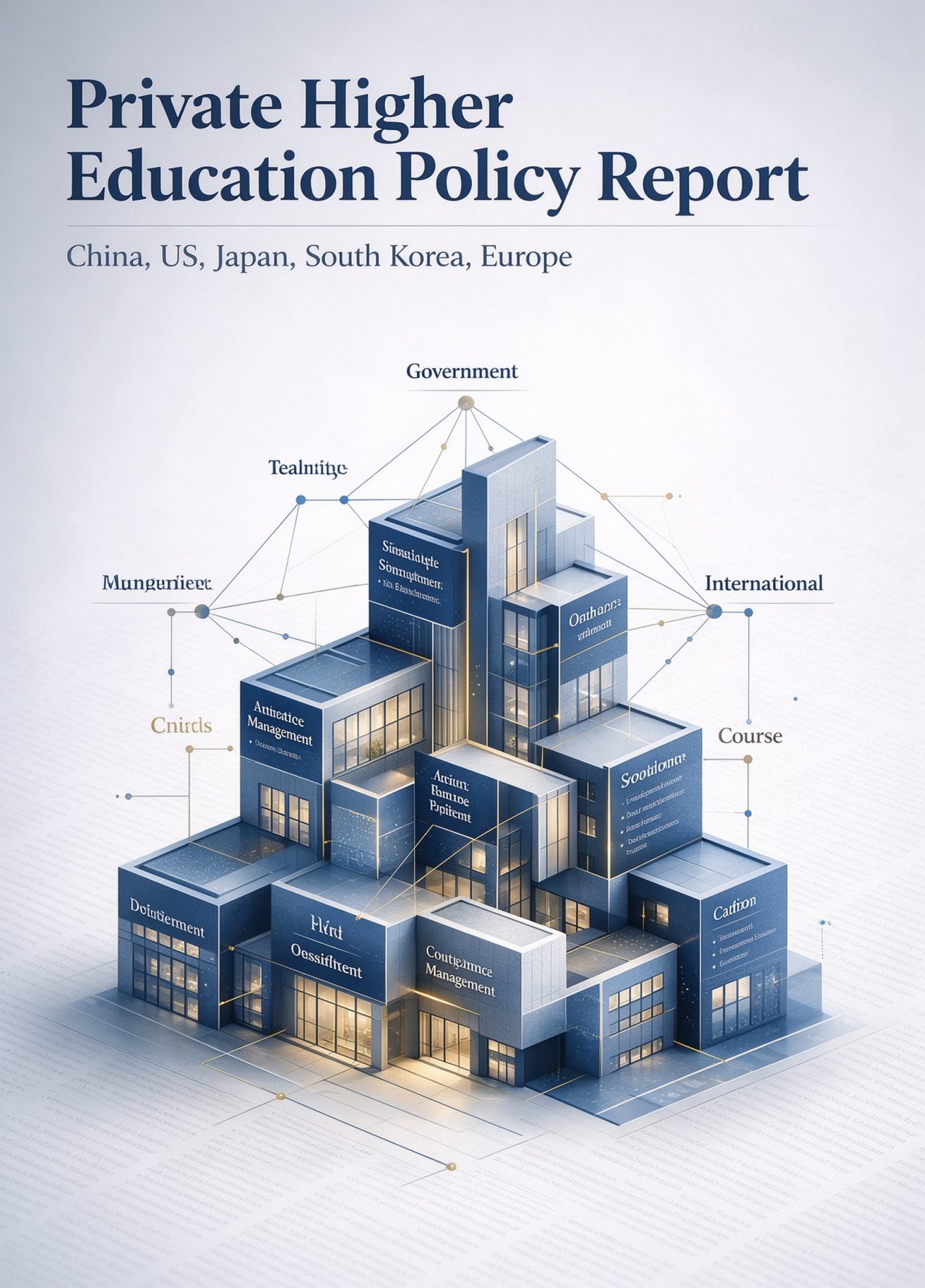
The Mode of State Presence: The Institutional Logic of China’s Private Higher Education Institutions and a Comparative Study of Global Private Higher Education
IAPUC Private Higher Education Policy Research Group
Abstract
China’s private higher education institutions (PHEIs) now enroll more than 10 million students, accounting for more than one quarter of all students in regular higher education institutions nationwide. Yet their institutional logic is fundamentally bifurcated from that of private universities in Europe, the United States, Japan, and South Korea. This paper proposes “the mode of state presence” as its core analytical framework and argues that the uniqueness of China’s PHEIs lies not in the attribute of being “private” itself, but in the fact that the state, through a system of classified management, embeds them in a supply system of “controllable quasi-public goods.” Private universities in the United States, Japan, South Korea, and Europe originated from the spontaneous construction of civil society, with the state subsequently intervening through regulation and funding; China’s PHEIs originated from the state’s limited loosening of public resources, with nongovernmental forces being “introduced” rather than “spontaneously” entering the field of higher education. This paper conducts a systematic comparison across five dimensions—governance structure, funding logic, faculty development, curricular positioning, and internationalization pathways—and puts forward five constructive policy recommendations, including “moving from classified registration to classified governance.”
Keywords
private higher education; classified management; state presence; international comparison; governance structure
I. Introduction: Why “Private” Is Not a Homogeneous Concept
The institutional logic of global private higher education is not a monolithic block. American private universities take endowment funds and board autonomy as their twin engines, while the federal government indirectly influences educational quality through accrediting agencies, forming a dual structure of “external regulation–internal autonomy.” Japanese private universities are subject to the dual constraints of the Private Schools Act and the standards for establishment approval of the Ministry of Education, Culture, Sports, Science and Technology (MEXT); MEXT exerts fiscal influence through the “subsidy for current expenses of private universities,” forming a “fiscal-guidance regulation.” South Korean private universities occupy an absolute majority in student enrollment, yet they have long oscillated between corporate autonomy and government approval. The external accounting audit system introduced in 2022 was intended to enhance independence, but because the Ministry of Education leads the selection of auditors, independence has once again been questioned.
The uniqueness of China’s PHEIs lies in the fact that they are not a natural extension of an existing private tradition, but an institutional arrangement consciously constructed by the state outside the public system through “education run by social forces.” As of June 2026, there were 840 private regular higher education institutions nationwide, accounting for 28.5% of all regular higher education institutions, with an enrollment scale of more than 10 million, an increase of nearly sixfold from 124 in 2001. This scale has made PHEIs a force in higher education that cannot be ignored, but scale itself does not explain institutional nature. The real question that must be asked is: when the state simultaneously plays the triple role of “regulator–funder–supervisor,” where is the boundary of “private”?
The analytical framework proposed in this paper is “the mode of state presence.” This concept points not to the degree of state intervention, but to differences in the institutional form of state involvement. Private higher education in the United States, Japan, South Korea, and Europe originated along an institutional evolutionary path in which “society precedes the state,” and the mode of state presence is “ex post regulation”; China’s private higher education originated along an institutional construction path of “the state ceding space,” and the mode of state presence is “ex ante embedding.” This difference in origins has shaped the basic direction of all subsequent institutional arrangements.
II. The Divide in Governance Structure: Autonomous Tradition and Regulatory Embedding
The governance core of American private universities is board autonomy. Almost all higher education institutions share the same basic governance structure—ultimate authority does not lie with faculty, students, or staff, but with the external board of trustees and the senior administration it appoints. Most private university trustees are selected by sitting trustees, and candidates are generally non-governmental figures from outside the institution; the federal government provides funding indirectly but does not directly intervene in internal governance. This is a dual structure of “external regulation–internal autonomy.”
The governance of Japanese private universities presents a hybrid form of administrative approval and corporate autonomy. Establishing a private university requires dual approval: “university establishment approval” from the Minister of MEXT and “approval of the endowment act of the school corporation,” but the daily operation of the school is autonomously handled by the school corporation. MEXT exerts influence through subsidies for current expenses, and increases or decreases in subsidies are linked to indicators such as the enrollment capacity fulfillment rate, forming a “fiscal-guidance regulation.” Corporate autonomy is not completely autonomous, but administrative power stops at approval and funding and does not penetrate into internal school decision-making.
The governance of private universities in continental Europe presents yet another path. Since the emergence of private higher education institutions in Germany in the 1980s, they have remained in an institutional space of “state-recognized but not state-run.” In principle, private higher education institutions have neither the right to demand state recognition nor the right to demand state funding, although some federal states provide direct financial subsidies. In 2001, German private higher education institutions received 79 million euros in subsidies, accounting for 25% of their total expenditure; by 2013, public funds still accounted for 16% of private higher education expenditure. The Wissenschaftsrat (German Science Council) is responsible for institutional accreditation of non-state higher education institutions and has so far successfully accredited 39; the accreditation procedure is aligned with the quality assurance framework of the Bologna Process. French private higher education is dominated by Catholic universities and business schools; state subsidies account for about 6% of their budgets, with the remaining 94% self-raised. This “low funding–high autonomy” model has enabled European private universities to maintain strong market responsiveness.
The governance structure of China’s PHEIs is essentially different from all three models above. According to the Implementing Regulations for the Law on the Promotion of Private Education, the decision-making body of a private higher education institution is the council or board of directors, but the grassroots organization of the Communist Party of China in a private school participates in major school decision-making and exercises supervision in accordance with the law, administrative regulations, and relevant state provisions. This means that, in addition to the board of directors, an organizational structure with statutory supervisory authority is embedded in PHEIs. At the same time, the classified management system divides PHEIs into for-profit and non-profit categories: the founder of a non-profit school may not obtain operating returns, and all operating surplus must be used for running the school; the founder of a for-profit school may obtain operating returns, and the operating surplus is handled in accordance with the Company Law.
The uniqueness of this institutional design lies in the fact that it replaces the “stratification” of traditional private universities with “classification.” There is a clear reputational stratification among American private universities—Harvard, Yale, and local liberal arts colleges share a “private” identity, but their resources, reputations, and governance models are entirely different. China’s classified management of PHEIs attempts to distinguish “public-interest orientation” from “for-profit orientation” within the same institutional framework, rather than relying on reputation stratification spontaneously formed by the market. In actual implementation, among the 643 PHEIs surveyed, only 10.7% explicitly chose for-profit status, 17.1% chose non-profit status, and as many as 72.2% had not yet started. By the first half of 2025, 67% of PHEIs had completed classified registration, of which 82% chose non-profit status. Whether this high proportion of “non-profit” choices is a genuine expression of public-interest motives or a strategic behavior under the policy incentive structure deserves deep reflection.
III. The Divide in Funding Structure: Market Dependence, Public Support, and Institutional Tight Constraints
Funding structure is a key window for understanding the institutional logic of private universities. The funding sources of top American private universities are highly diversified. Taking Harvard University as an example, endowment income accounts for 45% of its total revenue, tuition income accounts for 29%, and federal government and other non-governmental research subsidies account for 16%. The endowment is not only a financial reserve but also the material basis of governance independence. The government adopts an equal policy toward private universities through scholarships, loans, and research funding, but such funding is consumer-oriented—money follows students rather than being directly allocated to schools. Private universities can freely set tuition, and high tuition is accepted because it can provide more, better, and more diverse educational services.
The funding structure of Japanese private universities is dominated by tuition income, supplemented by government subsidies. MEXT’s subsidy for current expenses is the main policy tool affecting private universities. Subsidies are calculated according to indicators such as the number of faculty and staff and the number of students, generally within one-half of expenses. In recent years, subsidies have become increasingly linked to performance indicators such as the enrollment capacity fulfillment rate, intensifying differentiation among private universities against the backdrop of Japan’s declining birthrate. As of 2026, about 30% of Japanese private university corporations face financial difficulties, and 207 corporations have operating deficits, an increase of 33 from the previous year.
The funding structure of European private universities shows a “market-dominated, public-supplemented” characteristic. Data from the European Tertiary Education Register (ETER) show that private universities mainly rely on student tuition, and for some institutions tuition income accounts for as much as 95% of total revenue. Tuition at French Catholic universities varies by income; undergraduate annual tuition at the Université Catholique de Lille ranges from 3,150 to 7,900 euros, and state subsidies account for only 6% of the budget. Although German private higher education institutions can receive some state government subsidies, the subsidy proportion has fallen from 25% in 2001 to 16% in 2013, and in principle private higher education institutions have no right to state funding.
The funding structure of South Korean private universities is likewise dominated by tuition, with limited government financial investment. In the 2026 fiscal year, the total budget scale of private universities (including junior colleges) nationwide in South Korea reached 76.33 trillion won, an increase of 12.3% over the previous year. However, the proportion of corporate transfer funds in operating income fell to 3.5% in 2024, the lowest level since the 2020s, indicating that founders’ willingness to continue investing is declining.
The funding structure of China’s PHEIs presents a fourth logic—institutional tight constraints. The definition of a private higher education institution is itself one that “uses non-state fiscal funds” to operate. This means that government fiscal appropriations in principle do not constitute a regular source of funding for PHEIs. Data show that in 2021, among the income of private regular higher education institutions, tuition income accounted for 71.44%, national fiscal education funds accounted for 13.19%, and founder investment accounted for only 2.80%. Wang Chunxiu, a member of the National Committee of the Chinese People’s Political Consultative Conference, pointed out that the vast majority of PHEIs rely on tuition to roll forward, with tuition accounting for more than 85% of total school income. For some listed higher education groups, tuition income accounts for more than 90%.
This funding structure directly shapes the behavioral logic of PHEIs. When tuition is the lifeline and tuition standards are constrained by policy, scale expansion becomes the most rational strategy. This also explains why China’s PHEIs generally adopted a “quantity compensating for price” development model over the past two decades. However, the declining birthrate shock is changing the sustainability of this logic—in 2024, the number of students enrolled in private schools decreased by more than 3 million compared with the previous year, continuing the trend of decline seen in the previous year, and the fragility of the funding structure is shifting from a growth problem to a survival problem.
IV. Faculty and Curriculum: The Institutional Logic and Structural Tensions of an Applied Orientation
The faculty structure of China’s PHEIs faces a structural dilemma. Ji Ping, former director of the Higher Education Evaluation Center of the Ministry of Education, pointed out that the main problems in the faculty of PHEIs are “three highs and four lows”: high student-teacher ratio, high proportion of young teachers, and high difficulty for existing teachers to transform; low proportion of teachers with high degrees and senior titles, low rationality of teacher distribution by specialty, low proportion of dual-qualified full-time teachers, and low stability of high-level teaching staff. Lacking the support of public institution staffing quotas, PHEIs find it difficult to attract and retain high-quality talent; the proportion of full-time teachers is low, the team structure is unreasonable, and excellent talent frequently drains away, becoming a common industry dilemma. In the early years of establishment, a “dumbbell” structure generally appeared—one end was a large number of retired rehired teachers, the other end was new master’s graduates, and backbone teachers aged 35 to 50 were seriously absent.
The institutional root of this dilemma lies in the differential order of status. In public universities, public institution staffing quotas provide occupational security, pension benefits, and academic identity; although teachers in PHEIs enjoy equal rights in law with public university teachers, they are at a disadvantage in career expectations and social perception. Therefore, faculty development in PHEIs has to seek alternative solutions outside the system. Tianhua College of Shanghai Normal University, through its “strong teacher project,” trains and introduces doctoral teachers in stages, raising the proportion of teachers with doctoral degrees from less than 10% to 39%, and the proportion of dual-qualified teachers from 12% to 50%. Qingdao Huanghai University has 96.6% full-time teachers with enterprise backgrounds, and the proportion of dual-qualified teachers exceeds 90%. This is a path of “endogenous cultivation,” replacing staffing security with long-term career growth.
By contrast, although Japanese private universities also face faculty competition pressure, their tenure system provides a relatively stable talent pool for private universities, and the academic self-governance tradition of the faculty council also gives the teaching community institutional discourse power. The faculty market of American private universities is highly mobile, but the tenure system and academic freedom norms provide teachers with cross-institutional occupational security. The faculty of European private universities (especially in Germany and France) relies more on part-time and contract teachers, with a lower proportion of full-time professors, but the state recognition system provides teachers with cross-sector occupational mobility.
In terms of curriculum, China’s PHEIs generally position themselves as “applied,” which is both the result of policy guidance and the need for market survival. Xi’an Fanyi University integrated its original 10 secondary schools into 4 divisions and 2 schools, shifting to an integrated “admissions–training–employment” model; Zhengzhou University of Economics and Trade built a “four-chain linkage + five-force simultaneous promotion + five-innovation integration” system, focusing on advanced manufacturing and strategic emerging industries. This “industry-aligned” curricular logic is superficially similar to that of German Universities of Applied Sciences, but the difference is that the industry alignment of German Universities of Applied Sciences is built on the dual-system tradition and deep participation of industry associations, whereas the industry alignment of China’s PHEIs is more a one-sided market adaptation behavior of schools, and institutional participation by industry organizations is not yet mature.
A noteworthy comparison is that the curricular logic of American private liberal arts colleges is precisely a rebellion against market logic—taking liberal arts education as the core and not making vocational orientation the sole standard. International Christian University (ICU) in Japan, as a leading private liberal arts college in Japan, likewise takes liberal arts education as its core philosophy. There is almost no such “anti-market” curricular space in China’s PHEIs, which is both the result of resource constraints and the product of institutional positioning.
V. Recognition and Internationalization: Institutional Foundations and Path Choices
(1) The Institutional Foundation of Recognition and the Cognitive Gap
The academic qualifications of China’s PHEIs have the same legal effect as those of public universities. The Law on the Promotion of Private Education clearly stipulates that educatees in private schools enjoy equal rights with educatees in public schools of the same level and category in terms of further education, employment, and other aspects. Civil service examinations, graduate entrance examinations, judicial examinations, and others are all open to graduates of PHEIs. The academic qualification certificates and graduation certificates obtained by graduates of private and public universities have the same legal effect; at the level of national institutions, public and private education have always been treated equally.
However, there is a significant gap between legal equality and cognitive equality. The social prejudice that “private is inferior to public” remains deeply rooted, and many employers practice invisible discrimination against private diplomas in recruitment. In an environment of continuous undergraduate expansion, that slight difference on a diploma is often amplified many times over in the job market. The root of this cognitive gap does not lie in the private attribute itself—in the United States, Japan, and Europe, “private” does not inherently mean low quality—but in the historical starting point and development path of China’s PHEIs. The rise of China’s PHEIs was to a large extent a supplementary product of insufficient public higher education supply, rather than a competitive product established on excellence in quality or a unique mission. Once the initial positioning as a supplement became embedded in social cognition, even if the legal status has changed, cognitive inertia persists.
(2) A Multi-Country Comparison of Internationalization
The internationalization of global private universities presents different institutional paths. American private universities take global academic competition as their core, achieving deep internationalization through research cooperation, mutual recognition of degrees, and global alumni networks; their internationalization is a natural spillover of academic excellence. The internationalization of Japanese private universities is characterized by language-system innovation. Ritsumeikan Asia Pacific University (APU) offers undergraduate courses in both English and Japanese, with students from more than 100 countries and regions, who can complete a degree in either language. The Faculty of Liberal Arts at Sophia University teaches entirely in English, and its student body consists of people from more than 50 countries. Tokyo International University (TIU) offers fully English-taught degree programs covering business economics, digital business and innovation, international relations, and other fields. This is a fundamental reconstruction of the language of instruction and the institutional environment.
The internationalization of European private universities is based on a regional accreditation framework. The European Higher Education Area (EHEA) under the Bologna Process provides an institutional framework for cross-border quality assurance and mutual recognition of qualifications for private universities. The Standards and Guidelines for Quality Assurance in the European Higher Education Area (ESG) and the European Quality Assurance Register for Higher Education (EQAR) enable the degrees of private universities to gain systematic recognition across Europe. However, the depth of this internationalization is constrained by language barriers and differences in national educational traditions.
The internationalization of South Korean private universities is characterized by accreditation-driven development and expansion of the scale of international students. In 2025, 89.7% of all international students in South Korea were enrolled in private universities. The number of foreign students at private universities outside the capital region increased from 45,725 in 2024 to 56,884 in 2025, a one-year increase of 24.4%. But this is a “scale-oriented” internationalization, and the quality assurance system is still under construction.
The internationalization of China’s PHEIs presents two main paths. The first is the “cooperative export” type: introducing foreign degrees domestically through Chinese-foreign cooperative education programs. Guangzhou College of Technology and Business has established cooperative relations with 30 world-renowned universities in the United Kingdom, Australia, the United States, and other countries, and possesses Guangdong Province’s first non-independent legal-person Sino-foreign cooperative education institution approved by the Ministry of Education for a private university. Jilin International Studies University has carried out dual-degree programs with more than 200 universities in more than 40 countries and regions, receiving about 300 international students each year. The second is the “regional embeddedness” type: Guangxi’s private universities have more than 5,200 international students, an increase of 65% over 2020, of which students from ASEAN countries account for 88%, with Vietnam, Thailand, and Cambodia ranking in the top three. This is a differentiated internationalization path based on geographical advantages.
The fundamental difference between the internationalization paths of China’s PHEIs and those of Japan and South Korea is that the internationalization of Japanese and South Korean private universities is the result of the schools’ independent strategic choices, whereas the internationalization of China’s PHEIs is to a large extent constrained by policy space. Chinese-foreign cooperative education requires approval from the Ministry of Education, international student education requires qualification recognition, and mutual recognition of credits requires alignment of accreditation systems. When internationalization becomes a “permitted activity” rather than an “autonomous decision,” its depth and breadth are inevitably limited.
VI. Conclusion and Constructive Recommendations
(1) Core Judgment
The uniqueness of China’s PHEIs can be summarized in one sentence: They are not the Chinese version of “private universities,” but an institutional construct within a state-led quasi-public goods supply system. Private universities in the United States, Japan, Europe, and South Korea are products of “society preceding the state”; China’s PHEIs are products of “the state ceding space.” This difference in origin determines the systematic bifurcation in governance structure, funding logic, faculty development, curricular positioning, and internationalization pathways.
The classified management system is China’s latest attempt to re-regulate this institutional construct. Its original design intention is good: by distinguishing for-profit from non-profit, it gives non-profit schools policy support and social trust, while providing for-profit schools with legal operating space. However, in actual implementation, the high proportion of “non-profit” choices in classified registration (82%) suggests that the incentive structure of classified management may be biased—when “non-profit” becomes the default option rather than an active commitment, the regulatory function of classified management is diluted.
(2) Constructive Recommendations
First, move from “classified registration” to “classified governance.” At present, the focus of classified management is on registration, that is, determining the legal identity of schools; but the real challenge lies in governance, that is, whether the operating surplus of non-profit schools is truly all used for running the school, and whether the operating returns of for-profit schools are within a reasonable range. It is recommended to establish an independent financial information disclosure system for PHEIs, with annual audits by third-party institutions and public disclosure of key indicators, extending classified management from entry management to process management. At the same time, it is recommended to establish a “classification review” mechanism after the transition period ends, and for schools that have registered as non-profit but engage in disguised distribution of operating surplus, initiate reclassification procedures in accordance with the law.
Second, reconstruct the funding support logic for PHEIs. On the premise that tuition dependence is difficult to change in the short term, three supplementary mechanisms can be explored: first, establish a “money follows the student” system for student financial aid in PHEIs, extending national scholarships and grants equally to students in PHEIs, thereby indirectly improving the funding situation of PHEIs through the channel of students; second, draw on the German experience to establish a competitive special development fund for PHEIs, supporting schools that form differentiated advantages in specific fields and avoiding a one-size-fits-all subsidy model; third, improve donation incentive mechanisms, giving greater tax incentives to enterprises and individuals that donate to non-profit PHEIs, and cultivating a donation culture for private higher education.
Third, incorporate faculty development into the overall framework of national higher education talent policy. The occupational security problem of PHEI teachers cannot be solved by schools alone. It is recommended to gradually eliminate the institutional differences between public and private university teachers in terms of pensions, professional title evaluation, and academic project applications, so that “private university teachers” are first recognized as “university teachers.” The “endogenous cultivation” models of Tianhua College and Huanghai University are worth promoting, but they should not become the only path. At the same time, it is recommended to establish a national-level support plan for PHEI teachers’ enterprise practice, so that the cultivation of dual-qualified teachers rises from an individual school behavior to an institutional arrangement.
Fourth, replace the imitation strategy of “comprehensive internationalization” with “selective internationalization.” China’s PHEIs should not simply copy the internationalization model of research universities, but should choose differentiated paths based on their own positioning: applied PHEIs can focus on aligning with international technical standards and mutual recognition of professional qualifications in specific industries; regional PHEIs can rely on geographical advantages to carry out international student education for specific regions, as shown by the practice of Guangxi’s private universities facing ASEAN. It is recommended that the Ministry of Education set up a “differentiated channel” in the approval of Chinese-foreign cooperative education in PHEIs, giving priority approval to projects with clear regional positioning and industry alignment.
Fifth, establish a quality assurance system for the classified development of PHEIs. It is recommended to refer to the European ESG framework and the accreditation experience of the German Wissenschaftsrat, establish an independent quality accreditation body for PHEIs, and link accreditation results with financial support, enrollment plans, degree-granting authority, and other matters. Accreditation standards should reflect the requirements of classified management—non-profit schools should focus on public interest and educational quality, while for-profit schools should focus on market responsiveness and student satisfaction. Through the guidance of the accreditation system, gradually form a closed-loop institutional system of “classified management—classified accreditation—classified support,” promoting PHEIs to move from “supplementary provision” to “differentiated high-quality provision” and achieve steady and sustainable development.
IAPUC Private Higher Education Policy Research Group
October 10, 2026