


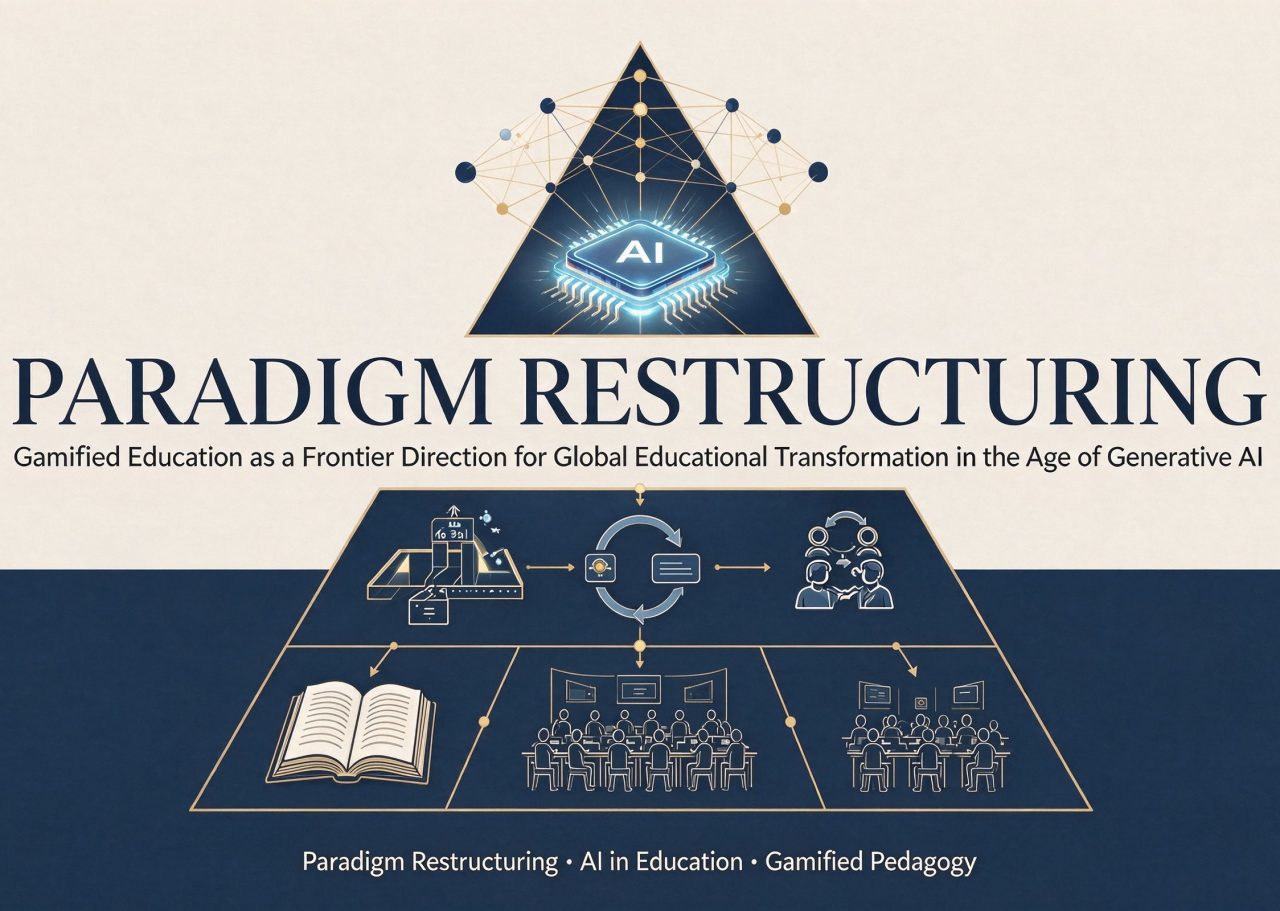
Paradigm Restructuring: Gamified Education as a Frontier Direction for
Global Educational Transformation in the Age of Generative Artificial Intelligence
Abstract
Generative artificial intelligence is not merely a new category of technological tools. It is reshaping the global chain of knowledge production, modes of cognitive division of labour, and the entire system of social value distribution. The educational paradigm inherited from industrial civilisation, built around standardised mass transmission of static knowledge, rests on the historical premise that knowledge was scarce and human labour bore repetitive cognitive workload. As large language models rapidly retrieve, synthesise, deduce and rephrase most explicit knowledge, the core mission of education undergoes a fundamental shift: education no longer prioritises training for memorisation and recitation. Instead, it must cultivate a cluster of higher-order competencies irreplaceable by AI: complex causal reasoning, creative construction, empathic collaboration, prudent value judgment, metacognitive reflection, and resilient inquiry within open, uncertain environments. Gamified education has long been reduced to superficial improvement, framed merely as classroom fun or video games in schooling. Its essence lies in extracting well-established cognitive design mechanisms embedded within game systems — stratified goal-setting, coherent rule systems, trial-and-error tolerance, multi-modal instant feedback, immersive narrative and distributed role-based collaboration. These mechanisms renegotiate power dynamics among learners, knowledge and teachers, rebuilding motivational chains and multi-dimensional evaluation frameworks. Augmented by generative AI, gamified education escapes historic constraints of static scripting, one-size-fits-all difficulty curves and delayed feedback, evolving into adaptive, dynamically responsive learning ecosystems tailored to individual cognitive trajectories. This paper adopts a macroscopic perspective of global educational governance and civilisational evolution, conducting side-by-side comparisons of institutional contexts, policy frameworks and on-the-ground practices across China, the United States, Finland, Singapore and Denmark. It interrogates mechanisms, value boundaries, nationally divergent pathways and cross-cultural shared risks of AI-augmented gamified education along five analytical axes: cognitive science, educational ethics, digital equity, teacher professional development and long-term civilisational risks. A closed-loop analytical framework is constructed, balancing learning efficacy, algorithmic ethics, educational equity and the protection of human subjectivity. This article argues that gamified education is neither superficial edutainment reform nor wholesale rejection of structured disciplinary knowledge. It constitutes one core viable pathway for educational paradigm evolution in the AI era. Its mature implementation will gradually reshape the fundamental forms of human learning; it is an emerging educational future already sprouting and stabilising across diverse global education systems.
Keywords: gamified education; generative artificial intelligence; adaptive learning; educational paradigm shift; comparative education; algorithmic ethics; human subjectivity
- Civilisational Shift: AI Redefines the Value Coordinates of Education and the Deep Structural Crisis of Industrial Paradigms
The modern national education system emerged from the Industrial Revolution, engineered to supply a standardised workforce equipped with uniform literacy, compliance and measurable assessable outcomes for assembly-line societies. Standardised school calendars, unified textbooks, synchronized pacing and summative examinations delivered high scalability efficiency when knowledge was costly to reproduce and access. This paradigm operates on foundational assumptions: knowledge is static, packaged and transferable; learning means moving knowledge from instructors and texts into learners’ memory; competence is measured by accurate reproduction of memorised content.
These century-old assumptions are progressively invalidated in the generative AI era. Learners can summon large models to complete literature searches, formulaic computations, composition drafting and basic problem-solving at any moment. Memorisation, recitation and elementary logical deduction, once treated as core academic competencies, are no longer exclusive human advantages. UNESCO’s Guidance for Generative AI in Education and Research repeatedly warns that future labour markets will prioritise capacities for tackling open-ended problems with no definitive answers, cross-agent collaboration, ethical deliberation, self-regulated learning and creative reconfiguration of reality. Such competencies cannot be cultivated through rote instruction and repetitive drilling. Transmission pedagogy excels at delivering fixed answers, yet fails to train human judgment under ambiguous, conflicting and incomplete information.
This paradigmatic crisis is universal, yet national responses are rooted in distinct civilisational backgrounds, educational traditions, governance structures and social competition regimes. No universal blueprint exists.
The United States builds its system upon federal decentralisation, market primacy and local autonomy. Federal authorities steer agendas through research grants and AI ethics guidelines, while innovation is driven by state school districts, charter schools, edtech startups and non-profit educational laboratories. Platforms including Kahoot, Prodigy, educational Quest ecosystems and serious STEM games are widely embedded in classrooms. Many charter schools adopt gamified project-based learning as a core differentiator. The market-led model enables rapid iteration and diverse product pipelines, yet carries inherent flaws: fragmented standards deepen resource gaps between districts. Affluent districts deploy VR terminals, AI adaptive gamified platforms and dedicated curriculum designers, while disadvantaged districts rely on free quiz tools. Gamification thereby amplifies pre-existing educational inequity. A further critical hazard arises: commercial edtech products are often optimised for user retention and engagement metrics rather than long-term cognitive growth, so incentive architecture can be captured by addictive commercial logic, subordinating pedagogical goals to product analytics.
Finland’s approach grows from Nordic humanistic educational philosophy, sustaining the long-standing conviction that play constitutes learning. Finnish educators show limited enthusiasm for heavily digitalised gamified products built around leaderboards and point rewards. The native platform Seppo delivers lightweight hybrid offline-online task packages, with gamified units integrated into forest education and phenomenon-based interdisciplinary inquiry. Finnish schools deliberately de-emphasise ranking, competition and punitive reward structures. Gamification’s primary objective is to safeguard intrinsic curiosity and exploratory behaviour, rather than rapid score improvement. This model faces persistent external pressure amid global AI competition: how to uphold foundational academic proficiency while preserving its low-stakes, slow, experience-centred ethos remains a central debate within Finnish education research.
Singapore pursues state-coordinated, curriculum-embedded and tightly regulated digital education. The Ministry of Education, alongside the National Institute of Education, has sustained long-term investment in theoretical research and curriculum deployment of game-based learning. Its Educational Technology Masterplan 2030 is paired with an independently auditable ethical framework for AI in schools. All educational games and simulation tools entering public schooling must pass joint evaluation by curriculum specialists and ethical review panels, with strict alignment to national curriculum benchmarks. The landmark simulation Statecraft X encapsulates statecraft, civic responsibility and game-theoretic logic within historical simulations, framing gamification as an official instrument for STEM, computational thinking and citizenship education. Singapore is among the few jurisdictions globally where gamified learning is fully integrated into national curriculum governance. It constructs a refined balance between innovation freedom and risk containment, though top-down rigorous review inevitably restricts grassroots teacher autonomy for experimental design.
Denmark codifies play as a fundamental right of children within early-years legislation. Danish gamification concentrates heavily on preschool and lower primary education, integrating art, drama, outdoor exploration, physical play and digital games. Within local educational discourse, play is not an auxiliary teaching aid but an innate mode through which children construct cognition and interpret the world. Digital tools remain supplementary, with priority given to screen-free, embodied, socially interactive play. This framework excels at nurturing imagination and empathy, yet its mature empirical base is confined to early childhood; pathways for migration into secondary and high-stakes disciplinary learning remain under exploration.
China’s experimentation arises from the interplay of an enormous public school system, the foundational objective of fostering virtue through education and the national digital education strategy. It diverges from the market priority of the United States, Finland’s deliberate de-emphasis of competition and Singapore’s centralised curriculum oversight. China’s gamified landscape features phased rollout, diversified scenarios and upstream ethical safeguards. Under revised curriculum standards, project inquiry, immersive drama pedagogy and scenario simulation are gradually embedded within literacy classrooms. Meanwhile, the national public educational digital infrastructure provides universal access to AI adaptive gamified learning, while binding rules govern algorithmic addiction protection and collection of minors’ sensitive data. China’s unique governance challenge lies in balancing foundational proficiency guarantees, innovative literacy cultivation and digital ethics compliance within a geographically vast system marked by stark regional, urban-rural and inter-school disparities. Policymakers must guard against two failures: gamification reduced to performative spectacle, or repackaged algorithmic drill-and-practice disguised as play.
Cross-national comparison yields a clear conclusion: gamification is not an institutional preference exclusive to one education regime, but a shared global response to the AI era. Nevertheless, a nation’s social fabric, educational values and governance model shape incentive architecture, evaluation regimes and risk governance for gamified education, with no universally transplantable optimal template.
- Fundamental Transition: How AI Resolves Historic Bottlenecks of Gamification and Reconstructs Motivation and Cognitive Loops
Prior to mainstream generative AI adoption, gamified learning had been researched for more than two decades, yet three structural bottlenecks restricted its scaling from experimental classrooms to mainstream deployment. First, levels, narratives, prompts and feedback were statically authored in advance, calibrated for average learners, unable to dynamically adjust to individual cognitive rhythms. Advanced learners experienced boredom, while struggling learners encountered repeated frustration. Second, reward systems centred on points, badges and leaderboards frequently triggered the classic motivation crowding-out effect: learners redirect their priority from knowledge comprehension toward reward accumulation, and intrinsic motivation collapses once extrinsic incentives are removed. Third, high-quality gamified curriculum design — custom narrative branching, differentiated tasks, granular learning analytics and scaffolding — imposes prohibitive workloads on teachers. Most educators lack sufficient time, skills and resources to develop bespoke content, forcing reliance on generic templates and resulting in homogenised implementation.
Generative AI transforms this foundational logic, converting fixed gamified scripts into dynamically self-adjusting cognitive ecosystems. First, AI sustains individualised flow states. Drawing on response traces, error mapping, interaction patterns and affective signals, AI recalibrates task difficulty, narrative branches, clue density and scaffolding in real time to anchor challenges consistently within the zone of proximal development, the flow state defined by Mihaly Csikszentmihalyi: challenges slightly exceed current mastery, yet remain attainable through deliberate reflection. Standardised whole-class instruction can only maintain uniform pacing, inevitably pushing many learners outside flow. AI-powered gamified systems can deliver simplified scaffolding and incremental cues for cognitively vulnerable learners, while opening extended inquiry branches for advanced students. This granular personalisation is structurally impossible within traditional classroom instruction.
Second, AI refashions feedback paradigms to weaken extrinsic reward and strengthen metacognitive reflection. Mature AI gamified environments de-emphasise badges and leaderboards as core incentives, prioritising diagnostic, explanatory feedback. Instead of merely marking answers correct or incorrect, the system reconstructs learner reasoning chains, identifies cognitive blind spots and misconceptions, proposes multiple alternative inquiry routes, and guides learners to reflect on their own thinking. It reorients gamification away from reward acquisition toward visibility of cognitive growth, mitigating the crowding-out problem that has troubled educational psychology for decades. This, however, imposes stringent requirements on algorithm design objectives: optimisation must target cognitive development rather than engagement or completion rates.
Third, AI drastically lowers barriers to narrative and scenario production, expanding the spectrum of gamified forms. Large models generate custom scripts, non-player character dialogue, inquiry prompts and simulation environments on demand, supporting open-world inquiry beyond quiz-based competition. Learners formulate hypotheses, design validation protocols, iterate through trials and observe systemic feedback within AI-simulated historical, ecological, physical or social game worlds. This mode directly trains systems thinking, scientific inquiry and causal modelling, precisely the human competencies most scarce in the AI age.
A critical boundary must be restated: AI is an amplifier, not a panacea. It magnifies both strengths and defects of underlying pedagogical design. If the foundational gamified framework remains reward- and leaderboard-driven, AI will refine behavioural capture with greater precision and deepen addictive risks, as repeatedly demonstrated by commercial edtech products in the United States. Technology is neutral; its moral trajectory is bounded by upstream educational purpose, ethical constraints and algorithmic audit mechanisms.
At a deeper cognitive science level, we must recognise the essence of gamification: it harnesses exploratory instincts forged through human evolution. Throughout human evolutionary history, low-risk trial-and-error play served as the primary arena for rehearsing survival strategies, social norms and environmental prediction. Play is not a civilisational byproduct, but an innate cognitive training mechanism. AI adapts this ancient cognitive architecture to modern formal knowledge systems.
- Shared Global Vulnerabilities: Ethical Divides, Equity Crises and Challenges to Human Subjectivity in AI Gamified Education
Across institutional and cultural boundaries, AI gamified education confronts homologous, cross-cultural deep risks. These risks preclude uncritical advocacy and stem not merely from technical defects, but from long-term propositions concerning human autonomy, social stratification and civilisational inheritance.
First, algorithmic manipulation and cognitive ethics risk undermine autonomous judgment. Game mechanics are systematically engineered to shape attention, decision loops and reward pathways. When paired with predictive recommendation systems, platforms gain continuous capacity to observe and steer learner choices. If optimisation priorities prioritise session duration and task completion over long-term cognitive maturation, covert cognitive manipulation emerges. Studies from Stanford and Oxford cognitive laboratories confirm that highly immersive simulations may blur the boundary between virtual simulation and physical reality, inducing false memory and distorted value framing; risks are amplified for adolescents with developing moral reasoning. For this reason, Singapore, China and the EU have sequentially issued ethical frameworks for AI in education, mandating auditable, traceable algorithm objectives and prohibiting engagement metrics as primary optimisation targets.
Second, digital divides translate into new cognitive stratification and reinforce educational inequity. AI gamified learning presupposes stable internet, intelligent end devices and computing resources. Gaps between high-income and low-income nations, between urban and rural regions within one country, and between households of disparate socioeconomic status, directly translate into unequal learning access. Affluent populations gain sustained access to high-fidelity AI simulation curricula, while disadvantaged learners rely on basic tools or no digital resources at all. Finland and Denmark deliberately preserve non-digital gamified pathways: outdoor inquiry, natural tasks, drama and tabletop simulations, as a deliberate hedge against dependency on digital-only routes. China’s national public education platform releases free lightweight resources to narrow regional gaps in computing and hardware. A civilisationally sustainable gamified ecosystem must maintain both digital and device-free alternatives, otherwise technological innovation entrenches and amplifies existing social inequality.
Third, the dataist trap: assessment distortion and formalism. Gamification inherently generates granular behavioural logs, and AI automates tracking of every choice, trial and dwell time. Behavioural data, however, is not equivalent to competence. When administrators equate completion progress, interaction duration and task metrics with learning outcomes, a new form of metric-driven gaming emerges: learners prioritise rapid progression over genuine inquiry, and gamification becomes another mode of digital high-stakes assessment. Finnish pedagogy deliberately minimises quantitative tracking as an institutional safeguard against this trap. China and Singapore adopt a dual governance framework: qualitative teacher judgment remains authoritative, supplemented by process evidence portfolios, clarifying that data serves only as reference evidence and cannot replace professional human interpretation.
Fourth, the crisis and redefinition of the teacher role, paired with systemic capacity gaps. Simplistic narratives claiming AI gamified systems can replace teachers are refuted by empirical evidence worldwide. Narrative ethical gatekeeping, value dialogue, emotional support, conflict mediation and attunement to student psychological states cannot be automated. Within the new paradigm, teachers evolve from primary knowledge deliverers into narrative designers, algorithm auditors, affective safety guardians, value calibrators and cognitive scaffolding architects. This role transition imposes a revised competency framework for educators, yet globally, training systems adapted to this new role are still in early construction. National training priorities diverge: the United States emphasises edtech literacy; Finland focuses on phenomenon-based and game-centred curriculum design; Singapore integrates AI ethics alongside curriculum mapping; China embeds digital literacy, AI pedagogy and educational ethics into continuous teacher professional development.
Fifth, a less frequently discussed yet vital civilisational risk: gamification’s inherent task-reward framing may, under prolonged immersion, instrumentalise all intellectual pursuits, conditioning learners to view knowledge-seeking exclusively as task-completion for extrinsic returns, eroding disinterested curiosity driven by pure wonder. This explains why Nordic systems deliberately de-emphasise extrinsic rewards and position protection of non-instrumental exploration as a top-tier objective.
- Future Trajectory: Consensus amid Global Divergence, Fusion Rather Than Replacement of Traditional Education
Viewed across the long history of human education, gamified education does not discard rigorous disciplinary frameworks, foundational training and core academic proficiency accumulated by traditional schooling. It redistributes cognitive labour under AI: AI handles standard exposition, repetitive practice, analytics and dynamic level generation; gamified mechanics deliver motivation awakening, situated immersion and safe trial-and-error inquiry; teachers facilitate high-order dialogue, ethical oversight, emotional scaffolding and value calibration; established disciplinary knowledge structures provide stable, rigorous cognitive backbones, preventing inquiry-based learning from dissolving into fragmented, unbounded, unstructured experience.
Synthesising global national trajectories, AI gamified education will evolve along three mutually reinforcing lines.
First, value-led, context-specific governance aligned with local cultural and social structures. High-competition societies prioritising uniform academic benchmarks (Singapore and China) will sustain curriculum alignment, ethical review and algorithmic oversight, treating gamification as a controllable instrument for literacy development. Humanistic Nordic nations will continue de-emphasising quantification and safeguarding intrinsic, disinterested exploratory motivation. The market-driven United States will oscillate between commercial innovation and public regulation, with public research laboratories and non-profit projects developing pedagogy-first AI gamified resources insulated from retention-focused commercial incentives. Across divergent pathways, a cross-national consensus is crystallising: educational purpose precedes game experience, and human subjectivity precedes data metrics.
Second, dual-track supply: digital and non-digital gamification coexist permanently as complements. Mature ecosystems will not rely exclusively on online AI simulation. Offline drama games, project inquiry, outdoor natural tasks, tabletop simulations and theatrical inquiry will support adaptive digital environments. This safeguards equity for learners without devices and breaks the monopoly of computing resources over learning opportunity. It also mitigates attention fatigue and health risks associated with prolonged screen exposure, preserving embodied perception and face-to-face social interaction within learning.
Third, paradigm shift in assessment: from terminal summative grading to evidence-based growth portfolios. AI gamified systems continuously capture process evidence, yet all data serves qualitative interpretation by teachers. Comprehensive portfolios integrate content mastery, collaborative performance, resilience amid failure, creative solutions and reflective journals. Assessment evolves from a one-off ranking instrument to sustained documentation of cognitive pathways, supporting learner self-reflection.
The ultimate end of education remains the free and holistic development of human beings. The core limitation of traditional education is not knowledge transmission itself, but its long-standing reliance on uniformity, pressure and decontextualisation, turning learning into externally imposed burden. The deep value of gamified education lies in reactivating humanity’s innate exploratory instinct; AI renders this instinct accessible through precise, equitable scaffolding. It does not demand perpetual amusement in learning, but removes gratuitous hardship and builds safe spaces for learners to practise the thinking, creation and value judgment that AI cannot perform on their behalf.
Conclusion
Generative artificial intelligence rewrites global knowledge production rules and labour division structures, exposing the inherent limitations of industrial-era standardised schooling. Gamified education, built on stratified goal-setting, permissive trial-and-error narrative and responsive feedback mechanisms, is empowered by AI to resolve historic barriers to personalised delivery and becomes a core pathway for nurturing uniquely human higher-order competencies. Worldwide, the United States, Finland, Singapore, Denmark and China pursue divergent models rooted in local educational traditions and governance architectures, validating gamification’s universal cognitive value while demonstrating that no single model can be transplanted independent of its civilisational soil.
This paradigm carries inherent risks: algorithmic manipulation, digital stratification, assessment distortion and instrumental rationality eroding disinterested curiosity. For this reason, all deployment must be bounded by three safeguards: algorithmic ethical audit, equity guarantees and teacher professional empowerment. Future-oriented education will not abandon rigorous disciplinary foundations, but embed coherent, systematic knowledge structures within gamified ecosystems that awaken intrinsic motivation and support open autonomous inquiry. AI-driven gamified education is no longer speculative science fiction. It is being piloted, iterated and trialled in classrooms, innovation programmes and literacy curricula worldwide. It does not simply replace old education; it facilitates slow reconstruction of humanity’s educational paradigm. It is the educational future steadily approaching us in the age of artificial intelligence.
References
[1] Guo J. Disrupting Traditional Education: Gamified Education as the Near-Future Prospect[EB/OL]. China National Radio, 2022‑02‑17.
[2] McGonigal J. Reality Is Broken: Why Games Make Us Better and How They Can Change the World[M]. Penguin Press, 2011.
[3] UNESCO. Guidance for generative AI in education and research[R]. 2023.
[4] Zainuddin Z, Chu S K W, Shujahat M, et al. The impact of gamification on learning and instruction: A systematic review of empirical evidence[J]. Educational Research Review, 2020.
[5] The Open University UK. Innovating Pedagogy 2019[R]. 2019.
[6] Chee Y S. Statecraft X: Games for learning, games for governance[J]. International Journal of Gaming and Computer-Mediated Simulations, 2011.
[7] Csikszentmihalyi M. Flow: The Psychology of Optimal Experience[M]. Harper & Row, 1990.
[8] Deci E L, Ryan R M. Self-Determination Theory: Basic Psychological Needs in Motivation, Development, and Wellness[M]. Guilford Press, 2017.