
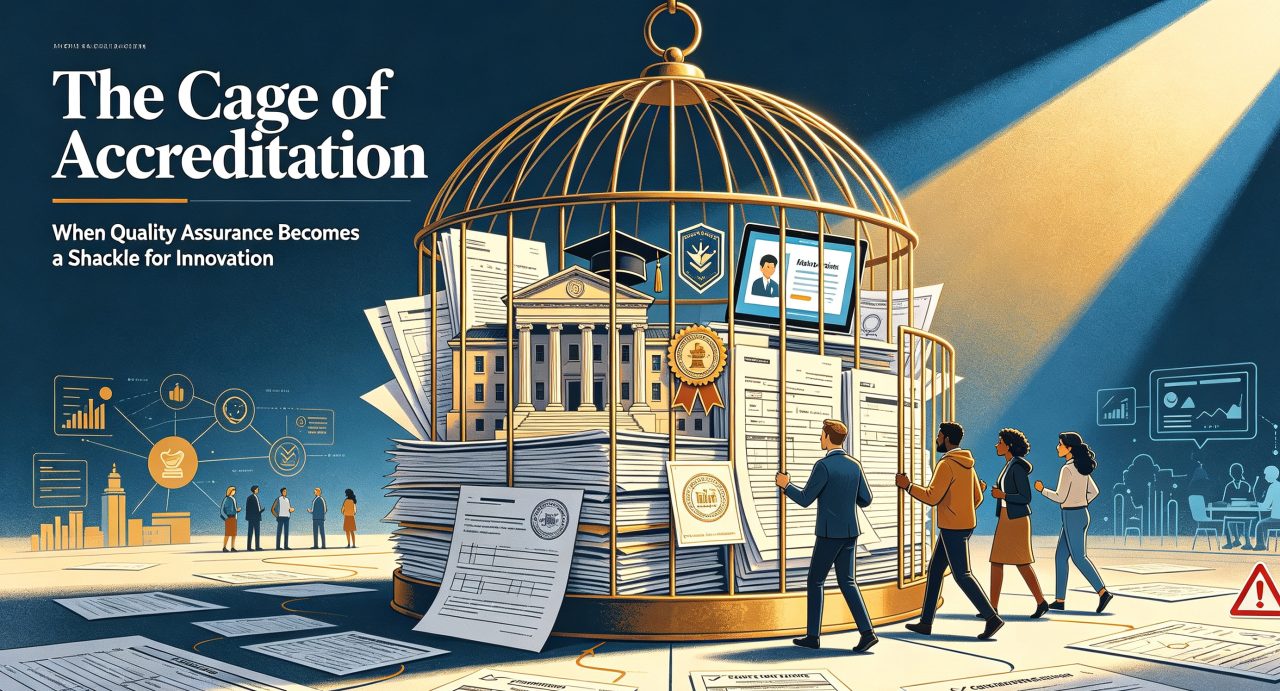
The Cage of Accreditation: When Quality Assurance Becomes a Shackle for Innovation
In May 2026, South African private higher education provider Stadio Holdings openly voiced strong dissatisfaction with accreditation procedures, criticizing that excessively long approval cycles are slowing down curriculum launches and stifling the expansion potential of the entire industry. The frustration of this listed education group is not an isolated case but a reflection of a global dilemma: across Africa, Europe, Asia, and the Americas, private higher education institutions are being constrained by a disjointed and outdated accreditation system.
The irony is almost absurd. While governments worldwide acknowledge the indispensable role of private education in expanding access to learning, driving educational innovation, and accommodating student populations that public systems cannot fully serve, they continue to bind private institutions to accreditation protocols originally designed for public universities — protocols that are slow, opaque, and largely irrelevant to the operational realities of private education providers.
A Cage Built for a Different Species
The original purpose of accreditation is quality assurance. In practice, however, it has often devolved into mechanical benchmarking against a fixed “university model”. This model originates from the institutional logic of public research universities, characterized by long-standing governance traditions, hierarchical academic councils, standardized academic calendars, and assessment systems centered on examinations and academic publications.
When private institutions — especially innovative providers focusing on vocational education, micro-credentials, flexible academic calendars, and workforce-based training — are forced to complete identical administrative forms, adopt identical governance structures, and comply with identical periodic review cycles, they are no longer undergoing genuine quality evaluation. Instead, they are trapped in fundamental institutional misalignment.
The first major cost of this misalignment is time. The journey from curriculum design to official launch can take several years under rigid approval pipelines, yet market demands and technological skill sets never pause for bureaucratic review. By the time a data analytics micro-credential finally gains accreditation after two years, the industry’s required technical competencies have already evolved. What was intended to serve as a quality threshold has instead become a speed bump for innovation.
A more subtle yet profound cost is systemic distortion. Faced with protracted approval processes and uncertain review outcomes, private institutions are incentivized to prioritize compliance over development. They hire specialized accreditation consultants, compile voluminous compliance documents, and restructure internal governance merely to match outdated template-based standards. Resources are diverted from teaching innovation and curriculum research toward performative compliance. As the adage goes, the tail begins to wag the dog. When accreditation turns into a game of “making institutions look standard”, genuine improvements in educational quality become secondary.
Whose Mission? Whose Definition of Quality?
The core debate is not whether accreditation is necessary, but what standards should govern accreditation. A quality framework that assumes all higher education institutions must conform to a single uniform model inevitably suppresses the diversity of modern educational ecosystems.
This is precisely the critical pain point addressed by the alternative approach of the IAPUC-IQA Framework. Instead of forcing institutions into a pre-established public university template, the framework requires each institution to articulate its unique educational mission and then evaluates whether it effectively delivers on its self-defined goals. A specialized college training frontline healthcare practitioners for local communities and a research university pursuing cutting-edge scientific breakthroughs should never be measured by identical criteria.
For community-focused vocational institutions, quality is defined by graduates’ clinical competencies and community service outcomes. For research-intensive universities, quality lies in academic publications, research contributions, and doctoral cultivation. The essence of “quality” differs fundamentally across diverse institutional missions.
The logical shift introduced by IAPUC-IQA is transformative. Quality is no longer judged by how closely an institution resembles a standard university template, but by how well it fulfills its own promised mission. This is not a lenient form of accreditation. It still demands rigorous goal formulation, verifiable empirical evidence, and systematic outcome evaluation. Yet it delivers greater relevance, fairness, and adaptability to modern educational diversity.
Breaking Bottlenecks and Rebuilding Trust
Critics may argue that mission-based evaluation risks enabling self-indulgence, allowing institutions to set low benchmarks for easy accreditation approval. This represents a fundamental misunderstanding of the framework’s methodology. The IAPUC-IQA Framework mandates that institutional goals must undergo peer review and external scrutiny, requires all outcome evidence to be independently verifiable, and demands alignment with national and international qualification frameworks. In short, institutions may freely define their educational identity, but once their mission is established, they are held to equally rigorous accountability for tangible delivery.
This model is particularly conducive to private education, as it fully recognizes institutional diversity. Private providers may be for-profit or non-profit, structured as universities, colleges, or corporate training academies, and may deliver fully online, offline, or hybrid learning models. Rather than forcing institutions to cut their feet to fit a single shoe, the framework requires each provider to demonstrate that its own model is effective, sustainable, and mission-aligned.
Admittedly, the widespread adoption of this new framework faces tangible resistance. The existing accreditation system is entrenched in deep administrative inertia and vested interests, making systemic reform far from straightforward. Nevertheless, Stadio Holdings’ grievance serves as a vital reminder: current bottlenecks are not merely technical issues — they are trust crises. When accreditation bodies are perceived by educational institutions as bureaucratic obstacles to circumvent rather than collaborative partners for quality enhancement, the entire system loses its legitimacy.
The future of higher education is inherently diverse. Micro-credentials, Recognition of Prior Learning (RPL), corporate universities, and transnational collaborative programs represent irreversible educational frontiers. These innovations will not disappear simply because traditional accreditation systems refuse to accommodate them; they will instead develop organically outside institutional boundaries.
Rather than clinging to outdated cages tailor-made for conventional public universities, the global education community should embrace inclusive, diversified quality assurance frameworks. The IAPUC-IQA Framework charts a clear path forward: quality assessment should no longer judge institutions by how well they fit a predefined standard, but by how fully they realize their own educational missions.
Otherwise, the rigid bottlenecks of outdated accreditation will continue to stifle an entire generation of educational innovation.