
IAPUC Holds the 2nd Extended Session of
the 3rd Expert Advisory Committee Meeting 2026
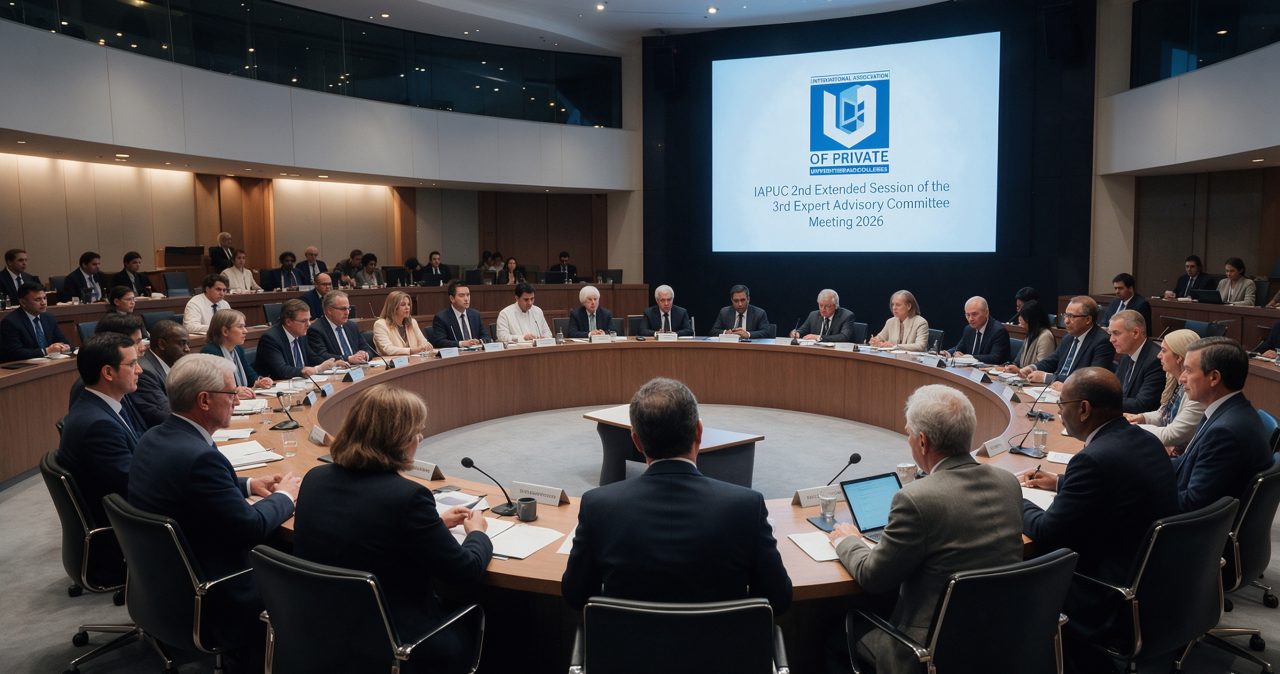
The International Association of Private Universities and Colleges (IAPUC) successfully convened the 2nd Extended Session of the 3rd Expert Advisory Committee Meeting of 2026 recently. Hosted in a hybrid online-offline format, the meeting gathered members of the IAPUC Expert Advisory Committee, leaders from the Accreditation Decision Committee, Quality Governance Division, Global Cooperation Division, and ESG and Sustainable Development Working Group. Invited university scholars, senior industry experts, and representatives from member institutions also attended the session. The meeting was presided over by the Chair of the IAPUC Expert Advisory Committee.
At the opening of the meeting, the IAPUC Secretariat delivered a comprehensive progress report on key work accomplished in the first half of 2026. The report systematically reviewed major progress across core priorities, including the iterative upgrading of the IAPUC International Quality Accreditation System, methodological improvement of the Global Private Higher Education Rankings, compilation of the Global Report on Private Higher Education Development, implementation of SDG-based university initiatives, and the expansion of cross-border institutional collaboration networks. The session also summarized existing challenges and clarified the phased roadmap for the second half of the year.
During the thematic discussion segment, participating experts conducted in-depth deliberations around four key agenda areas. First, the meeting reviewed the revision of IAPUC international accreditation standards and optimized compliance guidelines, discussing flexible and differentiated indicator mechanisms to accommodate diverse institutional contexts across global regions. Second, experts refined the framework of the global private higher education evaluation system, optimizing weight allocation, data governance mechanisms, and evaluation dimensions covering academic reputation, educational quality, sustainable development performance, and social contribution. Third, participants reviewed the preparation progress of the 2026 Global Higher Education Summit, the implementation of international academic exchange programs, and the collaborative governance mechanism of regional branches. Fourth, the meeting explored forward-looking topics including institutional governance innovation, talent cultivation reform, and risk prevention strategies for private higher education institutions in the artificial intelligence era.
Drawing on global higher education trends and regional institutional practices, advisory experts put forward professional suggestions regarding academic standardization, evaluation rationality, international operational implementation, and institutional risk management. Institutional representatives shared practical feedback on accreditation services, faculty development, joint research cooperation, and global partnership building, contributing a series of actionable recommendations for future work optimization.
The meeting reviewed and formally adopted multiple draft institutional documents, confirming the official work roadmap, task division, and key milestone arrangements for the second half of 2026. The committee emphasized that the Expert Advisory Committee shall continue to uphold academic neutrality and professional rigor, support the high-quality development of global private higher education, further improve the international quality assurance system, promote the integration of UN SDGs into institutional operations, and build a more inclusive and diversified global academic cooperation ecosystem to enhance the governance capacity and international influence of member institutions worldwide.
The Secretariat was instructed to fully integrate expert feedback, complete document revisions and project refinement in a timely manner, and disseminate meeting resolutions to all committee members and institutional partners to ensure steady implementation of annual strategic tasks.
The extended session effectively consolidated cross-regional consensus, expanded multi-stakeholder participation in expert consultation, and strengthened professional deliberation for major IAPUC decisions. It provides solid academic and institutional support for the association’s upcoming quality accreditation, global research, and international exchange initiatives throughout 2026.