The Severe Global Hazards of Diploma Mills and
the Urgent Need for Cross-National Governmental Intervention
Diploma mills, also universally termed degree mills, credential mills, or paper-degree factories, are unregulated, profit-driven commercial entities that operate outside legitimate higher education governance frameworks. Unlike formal academic institutions that award qualifications based on rigorous coursework, supervised research, examinations, and competency assessments, these fraudulent enterprises sell academic diplomas, degrees, transcripts, and credential verification services purely for monetary gain, with zero or minimal academic requirements for purchasers. Closely intertwined with “accreditation mills”—fake quality assurance bodies established to fabricate legitimate accreditation credentials for bogus educational providers—diploma mills have evolved from primitive 20th-century mail-order fraud schemes into a sophisticated, borderless transnational criminal industry.
Fueled by global digitalization, cross-border e-commerce, anonymous offshore server hosting, and surging demand for fast-track academic credentials amid competitive global labor markets, the diploma mill ecosystem has expanded exponentially across every continent. Recognized and documented by UNESCO, the International Network for Quality Assurance Agencies in Higher Education (INQAAHE), the OECD, and the Council of Europe, this pervasive academic fraud poses systemic threats to public safety, global labor market fairness, academic credibility, cross-border talent mobility, and governmental public trust. While non-governmental academic bodies have issued repeated warnings, the absence of unified, mandatory global governmental regulation has allowed diploma mill operations to proliferate unchecked. This article comprehensively analyzes the multi-layered global harms of diploma mills and emphasizes the indispensable, urgent necessity of coordinated governmental action worldwide to eradicate this transnational fraud crisis.
The Massive Scale of the Global Diploma Mill Criminal Industry
Contemporary global educational integrity research and transnational law enforcement investigations confirm that the diploma mill trade constitutes a multibillion-dollar unregulated shadow economy, with far-reaching global penetration and extremely high profit margins. As documented by cross-border fraud monitoring reports, the global fake credential market generates an estimated USD 3.5 to 5 billion annually, with operations active in more than 190 countries and territories, affecting both developed economies and emerging markets.
The most high-profile transnational diploma mill operation, Pakistan-based Axact, represents the industry’s staggering scale. Investigations revealed that Axact controlled a network of more than 350 fake universities and accreditation bodies, selling over 8 million fraudulent academic credentials to global clients, with cumulative annual revenue exceeding USD 1 billion. In the United States alone, federal and state law enforcement probes have uncovered individual domestic diploma mill operations that accumulated over USD 72 million in illegal profits within four years by selling unaccredited bachelor’s, master’s, and doctoral degrees targeting working professionals and public servants.
A 2024 research paper published in the International Journal for Educational Integrity further illustrates the industry’s predatory business model. Diploma mills maintain near-zero operational overhead: they require only a deceptive official website, basic printing facilities, fabricated faculty rosters, and fake online credential verification portals. With no classroom instruction, academic supervision, or assessment mechanisms, these fraudulent providers achieve profit margins exceeding 90%. Unlike legitimate higher education institutions that invest heavily in teaching resources, campus facilities, and academic research, diploma mills extract pure economic profit while imposing massive social, economic, and public safety costs on global societies.
Notably, the industry’s customer base has expanded dramatically in recent years. Beyond individual job seekers, diploma mill credentials are increasingly purchased by corporate mid-level managers, public administrative staff, licensed technical professionals, and even international migration applicants. Credentials are priced from USD 300 for basic undergraduate certificates to over USD 5,000 for fake doctoral degrees, with customized transcript modification and academic verification services available for additional fees, forming a complete industrial chain of academic fraud.
Multi-Dimensional, Systemic Global Harms of Diploma Mills
1. Imminent Public Safety and Life Security Risks
The most catastrophic and irreversible harm caused by diploma mills lies in the erosion of professional competency standards in safety-critical industries, directly endangering human life and public infrastructure security. Legitimate academic degrees and professional qualifications serve as core verification benchmarks for practitioners in healthcare, civil engineering, aviation operation, public security, fire safety, and clinical psychology. Diploma mill fraud allows unqualified, untrained individuals to bypass rigorous professional competency screening and obtain legal employment and licensing in these high-risk fields.
INQAAHE’s 2024 global fraud case database records hundreds of verified safety incidents linked to fake academic credentials worldwide. In multiple European Union member states, unlicensed medical practitioners holding diploma mill degrees have been found providing clinical diagnosis and surgical services, leading to medical errors, patient injuries, and avoidable deaths. In North America and Southeast Asia, construction engineers with purchased fake architectural and civil engineering degrees have participated in public infrastructure projects, triggering structural defects in buildings and roads that pose long-term public safety hazards.
A classic industry test case further exposes the absurdity and danger of diploma mills: multiple U.S. and European investigative journalists successfully registered pet dogs and cats as “students” at mainstream diploma mills, obtaining formal degree certificates and verifiable academic transcripts with no identity verification or academic assessment. This shocking experiment proves that diploma mill credentials represent zero professional competence, and practitioners relying on such qualifications pose an unpredictable, continuous threat to global public safety.
2. Severe Distortion of Global Labor Markets and Destruction of Fair Competition
Diploma mill fraud fundamentally undermines the core fairness of global talent competition and labor market resource allocation. Legitimate degree holders invest years of time, energy, and financial resources in formal academic study, accumulating professional knowledge and practical competencies through standardized educational systems. In contrast, diploma mill purchasers obtain equivalent academic credentials through simple financial transactions, becoming “free riders” on the global higher education reputation system.
This credential mismatch directly distorts corporate and governmental recruitment mechanisms. Unqualified applicants with fake degrees frequently outperform legitimate graduates in recruitment screening, securing high-paying positions, professional promotions, and industry licensing qualifications they are unfit to hold. A 2022 Council of Europe report on educational fraud confirmed that public sector institutions in over 40 countries have discovered civil servants holding diploma mill degrees, with many government agencies having mistakenly reimbursed tuition fees for these fraudulent credentials, resulting in direct misappropriation of public fiscal funds.
For employers, the economic losses are multi-layered and long-term. Enterprises incur redundant recruitment and onboarding costs when fraudulent credentials are exposed, suffer operational losses and business risks caused by employees’ insufficient professional capabilities, and face industry reputation damage and legal liability disputes arising from workplace errors. For legitimate job seekers, the prevalence of fake degrees depreciates the market value of authentic academic qualifications, reduces employment opportunities, and severely dampens public enthusiasm for pursuing formal higher education, disrupting the sustainable development of global talent cultivation systems.
3. Collapse of Global Academic Integrity and Cross-Border Institutional Reputation
Diploma mills and their affiliated accreditation mills have severely damaged the credibility of the global higher education quality assurance system. To deceive the public and employers, fraudulent institutions deliberately adopt names highly similar to world-renowned accredited universities, confusing credential evaluators, students, and international employers. This intentional name hijacking and brand counterfeiting tarnishes the global reputation of legitimate formal universities, causing unjustified reputation losses to standardized higher education institutions worldwide.
The fake accreditation ecosystem further exacerbates systemic deception. Unrecognized private accreditation mills issue counterfeit quality certification documents to diploma mills, creating a false illusion of “official accreditation” and formal academic qualification. This parallel fraudulent quality assurance system weakens the authority of global mainstream academic accreditation frameworks and devalues the universal recognition of legitimate academic degrees across borders.
Moreover, diploma mills have severely stigmatized legitimate online and distance education. As digital higher education has become a mainstream global educational model, fraudulent operators exploit the virtual characteristics of online education to cover up their credential-selling behaviors. This has led to widespread public suspicion of formal online academic programs, hindering the standardized development of global remote higher education and obstructing the popularization of inclusive digital education resources.
4. Devastating Personal and Professional Consequences for Credential Purchasers
While diploma mill operators reap huge illegal profits, individual purchasers bear irreversible professional, legal, and reputational losses. In nearly all developed countries and most emerging economies, the knowing use of unaccredited fake degrees for employment promotion, licensing application, academic admission, and immigration application is classified as academic fraud and commercial deception, subject to strict legal sanctions.
Once fraudulent credentials are uncovered, purchasers face mandatory dismissal from employment, permanent revocation of professional practice licenses, and lifelong industry entry restrictions. Their personal credit records will be permanently tainted, resulting in complete loss of career development opportunities. For international migrants and overseas students, fake degree submissions will lead to immediate visa rejection, permanent entry bans in destination countries, and disqualification from all cross-border academic and talent mobility programs.
Economically, most purchasers pay thousands of dollars for fraudulent credentials under the false premise of international recognition, yet these documents are completely invalid in global academic recognition, professional licensing, and immigration assessment systems. No legal channels exist for purchasers to recover their economic losses, resulting in dual losses of money and career prospects.
5. Obstruction of Cross-Border Talent Mobility and Global Governance Burdens
With the continuous acceleration of global talent circulation and international educational cooperation, diploma mill fraud has become a major obstacle to standardized cross-border talent mobility. A large number of applicants submit fraudulent academic credentials for skilled migration visas, international work permits, and cross-border professional qualification recognition, forcing national educational evaluation agencies, immigration departments, and labor regulatory authorities to invest massive public resources in fraudulent document verification.
The transnational operational characteristics of diploma mills create huge global governance loopholes. Fraud operators usually adopt a split operational model: registering institutional shells in low-supervision countries, deploying website servers in offshore regions, and targeting global customers through cross-border social media advertising. This cross-border decentralized model makes unilateral national law enforcement ineffective, resulting in long-term unregulated proliferation of fraudulent operations.
UNESCO’s 2025 global higher education integrity report points out that national qualification verification agencies worldwide spend an average of 15% of their annual public budget on identifying and intercepting fake academic credentials, severely squeezing public resource investment in legitimate educational development and talent service construction, forming a huge invalid consumption of global public governance resources.
The Critical Governance Loophole: Lack of Unified Global Governmental Regulation
For decades, the supervision of diploma mills has relied mainly on self-discipline of academic institutions and decentralized warnings from non-governmental quality assurance organizations, lacking mandatory, unified governmental regulatory mechanisms at the global level. INQAAHE, OECD, and UNESCO have repeatedly issued industry guidelines and risk warnings, but these documents are non-binding and lack cross-national law enforcement coordination mechanisms, failing to curb the rapid expansion of fraudulent industries.
National regulatory gaps further exacerbate the crisis. Some countries lack specialized legal provisions targeting diploma mill fraud, failing to define the illegal nature of credential sales and purchases, resulting in low illegal costs for fraud operators. Some countries have independent regulatory systems but lack cross-border judicial cooperation channels, making it impossible to crack down on transnational fraudulent operations, freeze illegal profit funds, and punish overseas operators. In addition, the absence of a unified global legitimate higher education institution database and real-time fraud warning mechanism leads to asymmetric information between countries, providing survival space for diploma mills to rebrand and migrate across borders.
Urgent Call for Unified Global Governmental Action to Eradicate Diploma Mills
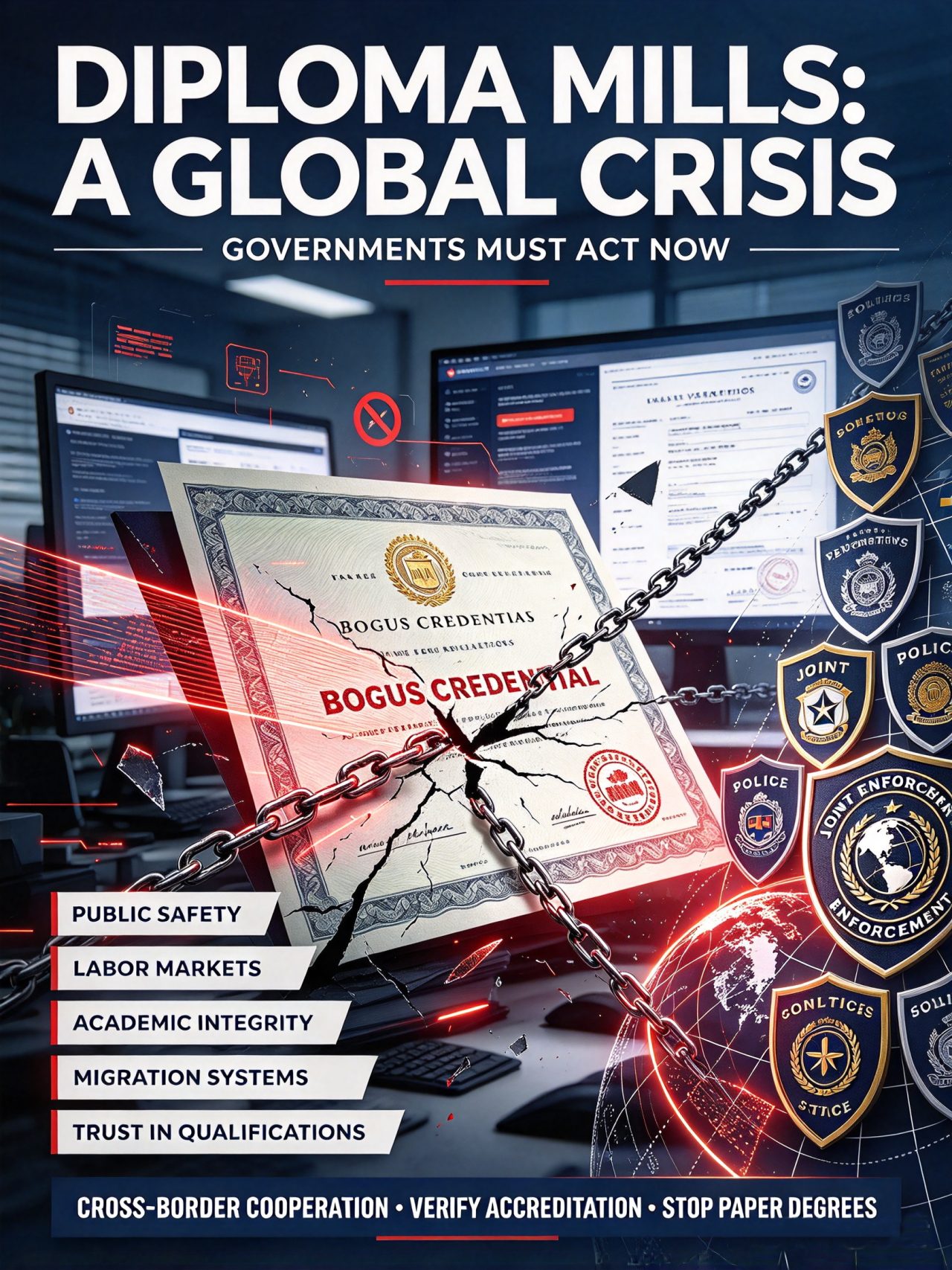
Given the systemic, transnational, and high-risk nature of diploma mill harm, unified, coordinated, and mandatory governmental intervention from all sovereign countries is no longer optional but imperative. Global academic integrity and labor market fairness require joint governmental governance rather than scattered industry self-regulation. Based on OECD regulatory recommendations, Council of Europe anti-education fraud frameworks, and UNESCO global governance guidelines, global governments should launch comprehensive multi-dimensional joint crackdown actions:
1. Establish Unified National Legal and Regulatory Systems
All national governments shall accelerate the improvement of specialized laws and administrative regulations targeting diploma mills and academic fraud. Clear legal provisions should be formulated to define the illegal acts of operating fake educational institutions, selling fraudulent academic credentials, and knowingly using fake degrees for employment and profit. Strict penalty mechanisms shall be established, including high fines, criminal detention, and industry prohibition orders, to significantly increase the illegal cost of academic fraud. National education regulatory authorities shall set up dedicated anti-diploma-mill supervision departments to conduct daily screening, investigation, and rectification of unaccredited educational institutions and online credential-selling platforms.
2. Build a Global Cross-National Law Enforcement Cooperation Mechanism
Governments worldwide should rely on international judicial cooperation platforms to establish a dedicated global diploma mill crackdown alliance. Countries shall realize real-time sharing of fraudulent institution blacklists, fraud case data, and operator information, and launch joint cross-border law enforcement operations targeting transnational diploma mill networks. Unified judicial extradition procedures and illegal fund freezing mechanisms should be formulated to completely cut off the profit chain of fraudulent operations and eliminate the cross-border regulatory loopholes exploited by diploma mills.
3. Launch a Unified Global Legitimate Education Institution Database
Led by UNESCO and supported by all national governments, a real-time, publicly accessible global database of officially recognized higher education institutions shall be established. All legitimate universities and academic programs worldwide will be included in the unified database, with real-time updates and open query functions for global employers, immigration departments, and academic institutions. Meanwhile, a global real-time warning list of fraudulent diploma mills and accreditation mills will be released to block the survival and rebranding paths of fraudulent institutions.
4. Strengthen National Publicity and Preventive Governance
National governments shall carry out nationwide public education campaigns to popularize the identification standards of diploma mills, clarify the legal risks and personal consequences of purchasing fake degrees, and curb market demand for fraudulent credentials from the source. Education departments shall integrate academic integrity education into basic and higher education systems to cultivate public awareness of respecting formal academic education and resisting academic fraud. Labor and human resource departments shall standardize enterprise recruitment credential verification standards to force enterprises to strictly verify academic qualifications and eliminate the employment space for fake degrees.
5. Standardize Cross-Border Higher Education Quality Supervision
Governments shall strengthen the supervision of cross-border online education and overseas educational institutions, strictly review the qualification and accreditation status of transnational educational providers, and ban unaccredited offshore educational platforms from carrying out academic enrollment and credential awarding activities domestically. Regional economic and educational cooperation organizations (EU, ASEAN, OECD, etc.) shall formulate unified regional anti-diploma-mill regulatory standards to realize integrated regional governance and form a multi-level global governance system combining regional coordination and global unification.
Conclusion
Diploma mill fraud is no longer a sporadic individual academic misconduct, but a large-scale transnational criminal industry that endangers global public security, economic fairness, academic credibility, and governance order. Its multi-dimensional harms have penetrated all fields of global social operation, and the passive supervision model relying on industry self-discipline has completely failed to adapt to the current severe fraud situation.
Only through comprehensive, unified, and coordinated joint governance by global governments can the root causes of the proliferation of diploma mills be eliminated. All sovereign countries should abandon decentralized independent supervision, strengthen cross-border judicial, educational, and administrative cooperation, improve legal penalty systems, build unified global supervision databases, and cut off the industrial chain of academic fraud from demand, operation, and law enforcement links. Through sustained and standardized global governmental intervention, the integrity of the global higher education system, the fairness of cross-border labor markets, and the safety of public social operation can be fundamentally protected, laying a solid foundation for the healthy development of global talent mobility and educational cooperation.
Media Reference Sources: UNESCO 2025 Global Academic Integrity Report, OECD Cross-Border Higher Education Supervision Guidelines, Council of Europe Anti-Education Fraud Recommendations, International Journal for Educational Integrity 2024 Research, INQAAHE Global Diploma Mill Case Database