
IAPUC Releases Research Report on the Development of Private Higher Education in China:
Sector Transitions from Scale Expansion to Value Demonstration
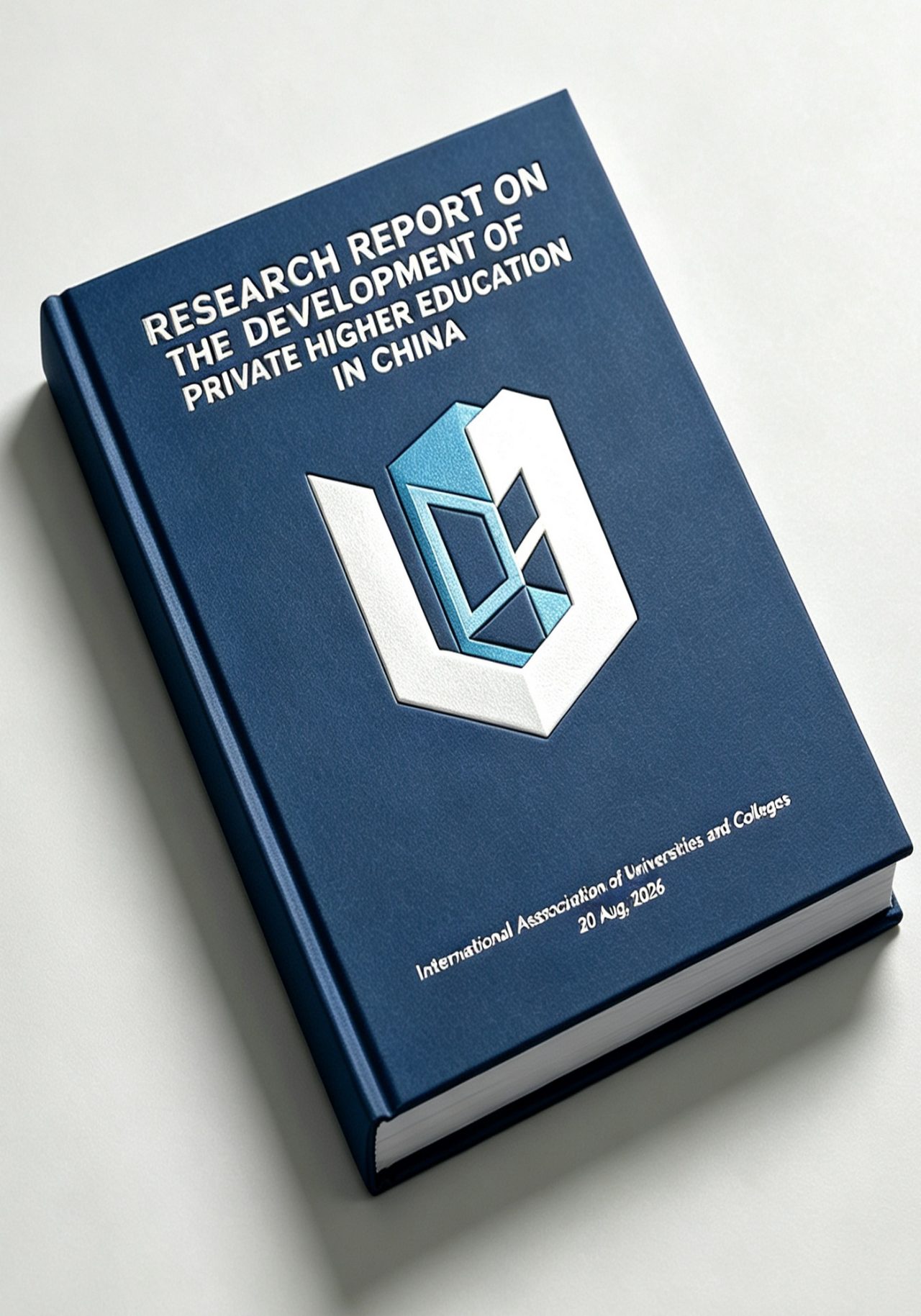
Shenzhen, August 20, 2026 — The research team of the International Association of Universities and Colleges (IAPUC) today officially released Research Report on the Development of Private Higher Education in China — From Scale Expansion to Value Demonstration: Structural Transformation and Strategic Choices, 2026–2042. Drawing on authoritative public data from the Ministry of Education, the National Bureau of Statistics, the OECD, and other sources, the report systematically examines the true position, demand inflection, capability foundations, and international experience of China’s private higher education sector, and proposes a three-phase strategic roadmap for the next fifteen years.
The Scale Dividend Ends as the Sector Enters a Period of Divergence
As of 2025, the report shows, there were 831 private higher education institutions (HEIs) nationwide, accounting for 26.24% of all HEIs. Enrollment in private general undergraduate, vocational undergraduate, and higher vocational junior college programs reached 10.6897 million, representing 27.04% of the national total. This means that more than one in every four undergraduate and junior college students attends a private HEI — private higher education has become infrastructure of China’s higher education system, not a marginal supplement.
Over the thirteen years from 2012 to 2025, the number of private HEIs grew by only 17.5% (from 707 to 831), while enrollment doubled (up 100.5%), and average enrollment per institution climbed from approximately 7,541 to 12,864. However, a critical signal emerged in the 2024–2025 academic year: the number of institutions grew by approximately 3.5%, while enrollment grew by only about 1.6% — new supply has outpaced new demand, marking the onset of “institution growth without proportional student growth.”
The report emphasizes that the stable national share of 27.04% masks a pattern of “head-group absorption and tail-group attrition.” The industry will not first experience a unified national inflection point, but rather an increasingly long tail.
The Faculty Resource Gap Is the Hardest Quality Constraint
The report reveals a structural contradiction more consequential than campus acreage: in 2024, private HEIs accounted for 27.04% of national enrollment, yet only approximately 21.7% of related full-time faculty — a gap of 5.3 percentage points. On a simple same-basis calculation, the student-to-faculty ratio in private HEIs was approximately 22.5:1, compared with the national average of 18.1:1.
This gap does not manifest directly as empty classrooms, but erodes quality in three hidden ways: the expansion of general education and large lecture classes; reliance on low-cost part-time instructors for practical courses; and core faculty burdened with excessive administrative and recruitment tasks. The report stresses that private HEIs need a “core faculty balance sheet,” reframing faculty investment from “labor cost” to “educational capacity.”
The Demographic Shock Is Real, but a “Comprehensive Cliff in 2026” Is a Misdiagnosis
On the widely debated issue of population decline, the report offers a clear timeline: national births fell from 17.86 million in 2016 to 7.92 million in 2025, a decline of 55.7% over the decade. Roughly projecting college entry at age 18, the 2016–2017 birth peak corresponds to a high point in the university-age population around 2034–2035, while the post-2020 birth collapse transmits in a concentrated wave around 2038.
The report divides the next fifteen years into three phases: 2026–2030, the Window Period, whose core task is completing capability reconstruction; 2031–2037, the Divergence Period, in which recruitment gaps among institutions widen and customer-acquisition costs for weak-brand institutions soar; and post-2038, the Contraction Period, in which the traditional fresh-graduate market undergoes sustained nationwide contraction and HEIs shift from one-time four-year education to lifelong learning platforms.
Private HEIs have approximately ten years of an active transformation window, the report notes, but truly effective capability building requires at least three to five years.
Employment Shifts from a Promotional Metric to a Recruitment Constraint
The graduating class of 2025 is projected at 12.22 million, and the class of 2026 at 12.70 million — an increase of 480,000 in a single year. The 14th Five-Year Plan for Education Development explicitly establishes an employment red/yellow-card warning system and strengthens the linkage between employment outcomes, enrollment quotas, and talent cultivation.
The greatest danger for private HEIs, the report argues, is not “low employment rates,” but being able to publish only an employment rate that cannot explain quality. What truly builds recruitment reputation is what positions graduates enter, how quickly they stabilize, whether they apply learned capabilities, and whether they continue to grow after several years. The report recommends that private HEIs disclose a minimum set of employment-quality indicators, including placement rate at six months post-graduation, median starting salary, social insurance coverage rate, program relevance, 6/12-month retention rates, and employer rehiring rates.
Provincial Landscape Determines Institutional Destiny
As of June 2026, five provinces — Henan, Sichuan, Guangdong, Shandong, and Jiangsu — each host more than 45 private general HEIs, with Henan leading at 60. By private share, Chongqing (42.9%), Hainan (41.4%), and Fujian (41.1%) rank highest.
The report warns that high-density regions offer both mature markets and fiercer homogeneous competition. Recruitment strategies that fail to simultaneously examine net population inflow, industrial structure, and public-sector expansion will misjudge “large provinces” as “safe markets.” For high-share provinces, governments should move beyond annual inspections and establish a provincial capacity model that places enrollment quotas, graduate destinations, program redundancy, faculty supply, and institutional cash-coverage months on a single dashboard.
International Experience: Exit Mechanisms Must Be Established Before a Crisis
Comparing the private higher education models of Japan, Korea, Taiwan (China), and the United States, the report distills four common patterns:
- Private can be the main supplier, but public responsibility does not thereby diminish. In Japan, private universities educate approximately 73.8% of students; the key lies in corporate governance, subsidy conditions, and quality oversight forming constraints.
- Demographic contraction first hits weakly positioned and homogeneous institutions. In fiscal 2024, 59% of Japanese private universities did not meet their enrollment quotas, yet the national overall quota fulfillment rate remained 98.2%.
- Public funds should purchase public outcomes, not compensate all losses. Korea’s RISE program places at least half of the Ministry of Education’s higher education support budget under regional coordination, binding institutional destiny to local industry and population strategy.
- Exit mechanisms must be established before a crisis. Taiwan (China), through dedicated legislation, has institutionalized student placement, faculty wage priority, and the public-interest disposition of residual campus assets; as of August 2025, 17 junior colleges and universities had ceased operations.
Four Types of Institutions, Four Different Futures
The report classifies private HEIs into four categories with differentiated strategies: Flagship Applied Universities should move from “applied undergraduate” to “applied research university,” building professional degree and applied research platforms; Regional Industry-Oriented HEIs should form talent communities with local enterprises, achieving joint recruitment, cultivation, and evaluation; Urban Professional HEIs should capture the adult and new-occupation market, breaking degree courses into stackable certificates; and Vulnerable Homogeneous HEIs should shrink scale early, merge programs, and seek trusteeship or orderly exit rather than continuing debt-fueled expansion.
The report concludes that China’s private HEIs accomplished the important mission of higher education massification in the past period. In the next phase, society will no longer ask “is there a place to study?” but will continuously ask “what was learned, can a good job be found, is the tuition worthwhile, is the institution reliable?”
Over the next decade, the core competitiveness of private HEIs can be compressed into three sentences: prove tuition is worthwhile through outcomes, prove operational reliability through investment, and prove long-term trustworthiness through governance.
The data cut-off date for this report is July 29, 2026. All core data cite verifiable public sources.
File Download: Report on the Development of Private Higher Education in China