


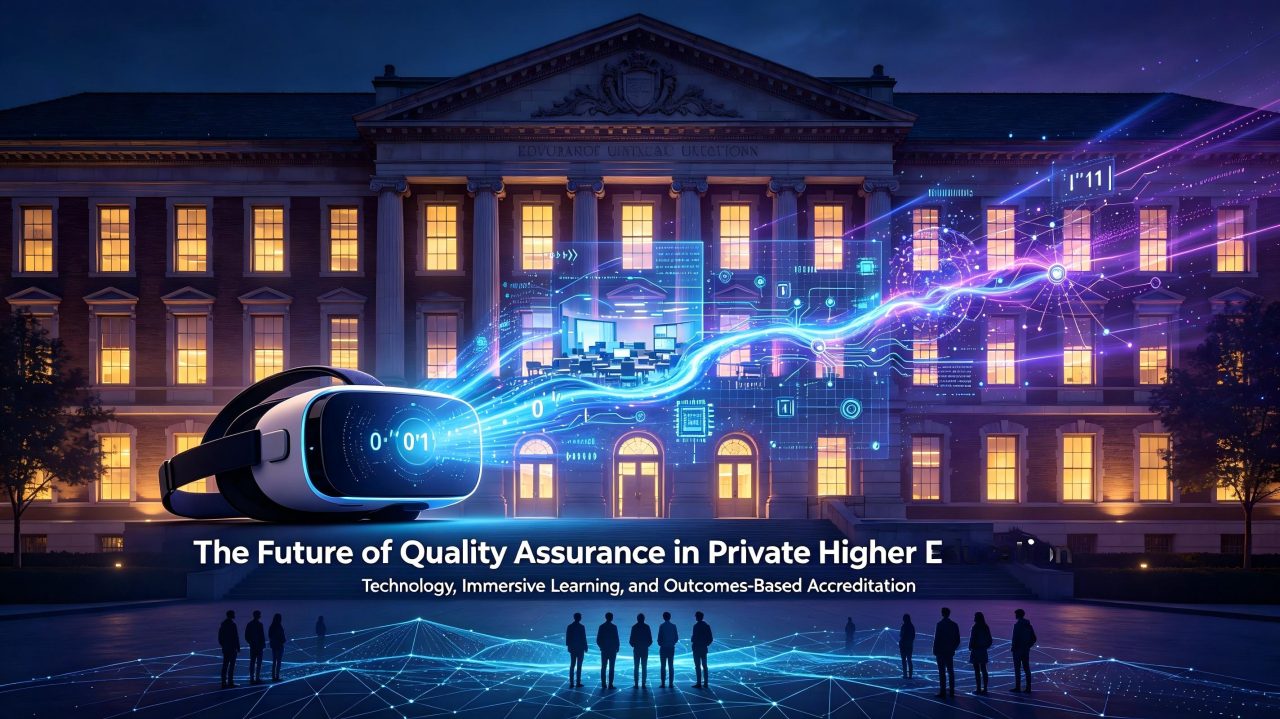
Digital Transformation and the Future of Quality Assurance in Private Higher Education
Abstract
Digital transformation is reshaping higher education at an unprecedented pace, challenging traditional assumptions about teaching, learning, and quality assurance. Virtual reality (VR) technology, as a core immersive medium of extended reality (XR), has gradually broken the spatial and dimensional limitations of traditional pedagogy, becoming a pivotal driving force for reconstructing modern university teaching systems. This paper examines the implications of digital transformation for quality assurance in private higher education. It argues that technology is not merely a tool to be managed but a force that fundamentally redefines what quality means and how it should be assured. Drawing on recent research and case studies, the analysis explores the innovative advantages of digital teaching in solving problems such as disjointed theoretical and practical teaching, insufficient high-end experimental resources, and single interactive modes. It also discusses current bottlenecks, including uneven global resource allocation, immature standardized teaching systems, and high hardware and operation costs. The paper concludes that quality assurance frameworks must evolve to address these new realities, focusing not on the technology itself but on the learning outcomes it enables.
Introduction: The Digital Restructuring of Higher Education
Global higher education is undergoing a profound digital restructuring driven by emerging technologies. Traditional models, dominated by offline classroom indoctrination and limited laboratory practice, are increasingly unable to adapt to the talent training demands of interdisciplinary integration, complex scenario application, and global collaborative innovation.
In professional fields such as medicine, engineering, aerospace, and environmental science, the limitations of traditional teaching are particularly prominent: high-risk experimental operations are difficult to replicate repeatedly, and large-scale engineering scenarios cannot be easily simulated. Digital technologies, particularly VR and artificial intelligence (AI), offer new possibilities for addressing these limitations.
The Promise: New Capabilities for Teaching and Learning
Digital technologies offer several distinctive advantages for higher education.
Immersive Learning: VR technology creates immersive learning environments that allow students to experience scenarios that would be impossible or dangerous in the real world. Medical students can practice surgical procedures; engineering students can explore complex machinery; environmental science students can simulate ecosystem dynamics.
Personalized Learning: AI-powered adaptive learning systems can tailor instruction to individual student needs, providing customized feedback and learning pathways. This personalization has the potential to improve learning outcomes and reduce dropout rates.
Global Access: Digital technologies enable the delivery of high-quality education to students regardless of their geographic location. This is particularly important for private institutions seeking to expand their reach and serve diverse student populations.
The Challenge: Quality Assurance in a Digital Age
The digital transformation of higher education poses significant challenges for quality assurance.
Uneven Resource Allocation: The benefits of digital technologies are not evenly distributed. Institutions in developing regions may lack the infrastructure, hardware, and technical expertise to implement advanced digital teaching methods. This digital divide threatens to exacerbate existing inequalities in higher education.
Immature Standardized Teaching Systems: The integration of digital technologies into teaching requires new pedagogical approaches, new assessment methods, and new quality assurance mechanisms. These systems are still immature, making it difficult to ensure consistent quality across different institutions and contexts.
High Costs: The hardware, software, and training required for effective digital teaching represent a significant investment. For many private institutions, particularly smaller ones, these costs may be prohibitive.
Data Privacy and Security: The use of digital technologies in education generates vast amounts of data about students. Ensuring the privacy and security of this data is a significant challenge, requiring robust governance frameworks.
The Response: Evolving Quality Assurance Frameworks
Quality assurance frameworks must evolve to address the challenges of digital transformation. This evolution requires a shift in focus from inputs (e.g., technology infrastructure) to outcomes (e.g., student learning).
The IAPUC-IQA framework provides a model for this evolution. By focusing on institutional mission and demonstrated outcomes, rather than on specific inputs or methods, the framework is flexible enough to accommodate diverse approaches to digital teaching. The key question is not whether an institution uses VR or AI, but whether the use of these technologies enhances student learning.
Conclusion
Digital transformation is not a trend to be managed but a fundamental shift in how higher education is delivered and experienced. Quality assurance frameworks must evolve to address the new realities of digital teaching and learning. This evolution requires a focus on outcomes rather than inputs, a commitment to equity and access, and robust governance of data privacy and security. The IAPUC-IQA framework, with its mission-driven, outcomes-based approach, is well-positioned to lead this evolution.