
IAPUC IQA Coordination Team Conducts On-Site Review at The Asia Pacific School of Business (Hanoi Campus)
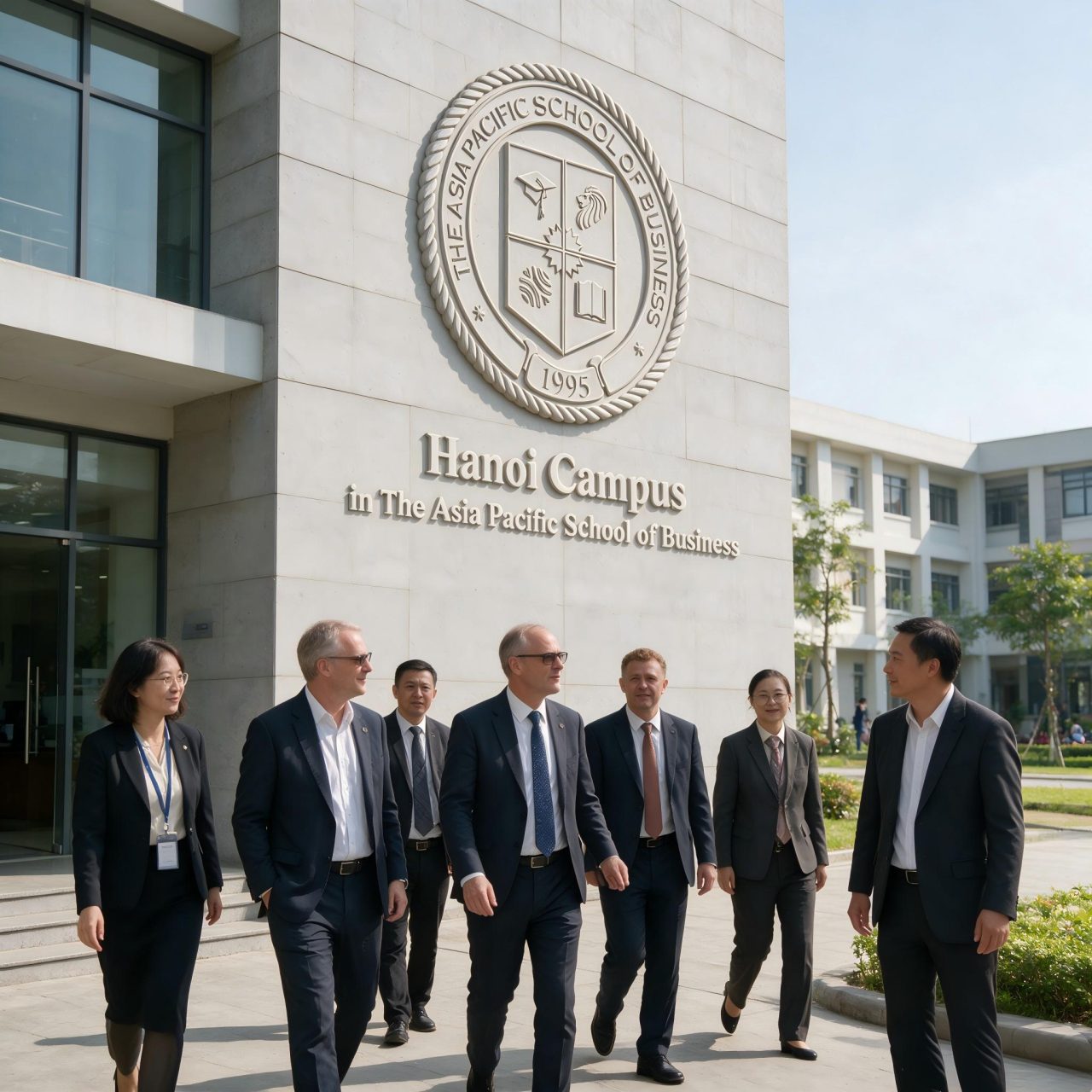
Hanoi, Vietnam – 18 January 2026 – A high-level accreditation coordination team from the International Association of Private Universities and Colleges (IAPUC) has completed a comprehensive on-site review at The Asia Pacific School of Business (APSB) Hanoi Campus, marking a significant step in the institution’s pursuit of institutional quality assurance (IQA) certification under the IAPUC-IQA framework.
The three-day mission, which concluded on 20 July, brought together a panel of international quality assurance experts, regional higher education regulators, and IAPUC secretariat staff. The team was led by Professor Michael Tan, Chair of the IAPUC-IQA Coordination Group, and included Dr. Elena Vásquez, Senior Quality Assurance Advisor, and Mr. Koji Yamamoto, Accreditation Specialist for Southeast Asia.
The review focused on assessing APSB Hanoi’s alignment with the IAPUC-IQA framework’s core principles: clearly defined learning outcomes, rigorous and transparent assessment practices, robust internal quality monitoring systems, and coherent articulation pathways for both traditional degree programmes and emerging credentials such as micro‑certificates and recognition of prior learning (RPL). The team examined institutional governance structures, faculty qualifications, student support services, and the quality assurance mechanisms applied across the campus’s portfolio of undergraduate and postgraduate business programmes.
“The Asia Pacific School of Business has demonstrated a strong commitment to embedding quality assurance at every level of its operations,” said Professor Tan in a statement following the closing meeting. “Our review was not merely a compliance check—it was a strategic dialogue about how the institution’s stated mission translates into measurable outcomes for its students and stakeholders. We were particularly impressed by the campus’s innovative use of industry-aligned curricula and its transparent stacking rules for modular credentials, which reflect the very spirit of the IAPUC-IQA framework.”
Dr. Nguyễn Thị Lan, Rector of APSB Hanoi, welcomed the review as a valuable opportunity for institutional reflection and improvement. “We chose to pursue IAPUC-IQA certification because we believe in accountability that is mission‑sensitive and evidence‑based,” she said. “The coordination team brought a fresh perspective that went beyond box‑ticking. Their recommendations will help us sharpen our assessment methods and strengthen our linkages with employers and professional bodies across the region.”
The on‑site review included classroom observations, document audits, focus group discussions with faculty and students, and virtual interviews with alumni and industry partners. The coordination team also visited the campus’s simulated trading floor, entrepreneurship incubator, and digital learning hub—facilities that underscore APSB’s emphasis on experiential and technology‑enhanced education.
A preliminary report will be submitted to the IAPUC-IQA Standing Committee within four weeks. If the findings are favourable, APSB Hanoi will be recommended for full IQA certification, joining a growing network of private higher education institutions worldwide that have adopted the framework to demonstrate quality assurance that is both rigorous and institution‑specific.
The IAPUC-IQA framework, developed by IAPUC in consultation with UNESCO and regional quality assurance networks, offers an alternative to traditional accreditation models that often impose one‑size‑fits‑all standards. It evaluates institutions against their own missions, while insisting on international benchmarks for learning outcomes, assessment integrity, and continuous improvement. The framework has gained traction across Asia, Africa, and Latin America as a practical tool for private providers seeking credible quality validation without sacrificing their distinctive character.
“This review is part of a broader effort to build a differentiated quality assurance ecosystem that recognises the diversity of higher education provision,” added Professor Tan. “The Asia Pacific School of Business is a case in point—it is not a public university, nor does it aspire to be. But it is a serious educational institution that takes its responsibilities to students and society seriously, and it deserves an accreditation process that takes it seriously in return.”
The IAPUC-IQA Coordination Group is scheduled to conduct similar reviews at partner institutions in Malaysia, Kenya, and Colombia later this year. For more information about the framework and the accreditation process, visit www.iapuc.org/iqa.
Media Contact:
Ms. Claire Bennett
Communications Director, IAPUC
Email: communications@iapuc.org
Phone: +1 (720) 897-8865