
The New Frontier of Quality Assurance
How Micro-Credentials and Recognition of Prior Learning Are Reshaping Higher Education Accreditation
Traditional higher education stands at a crossroads. Degree certificates are no longer the sole measure of knowledge and competence. Micro-credentials and the Recognition of Prior Learning (RPL) are expanding at an unprecedented pace, reshaping society’s understanding of what constitutes valid learning.
According to statistics from Class Central, the world’s top ten massive open online course (MOOC) platforms offer more than 4,170 types of micro-credentials, 60% of which are concentrated in business, programming, and computer science fields. Additionally, approximately 800 universities provide micro-credential courses on three major platforms: Coursera, edX, and FutureLearn. These figures underscore an irreversible trend: education is shifting from lengthy four-year degree programs to modular, flexible, and personalized learning pathways.
Nevertheless, expansion has been accompanied by chaos. Micro-credentials are offered by a diverse range of providers, from top-tier universities and industry training institutions to open learning platforms and professional associations. There exist substantial discrepancies in the definition of learning outcomes and wide disparities in quality. As pointed out in the African Continental Qualifications Framework (ACQF) Handbook, “Quality assurance remains a key challenge for micro-credentials, as education systems are designed to validate formal learning outcomes.” RPL faces similar dilemmas: to date, there is no unified standardized framework for the fair and consistent assessment of knowledge and competencies acquired through work experience, informal learning, and even life experiences.
Against this backdrop, the introduction of the IAPUC-IQA Framework is particularly timely.
Measuring Diverse Learning with a Unified Yardstick
The core insight of the IAPUC-IQA Framework is that quality assurance standards should not be lowered or altered based on different forms of learning. Traditional degrees, micro-credentials, and learning outcomes recognized via RPL must all be subject to the same rigorous quality scrutiny.
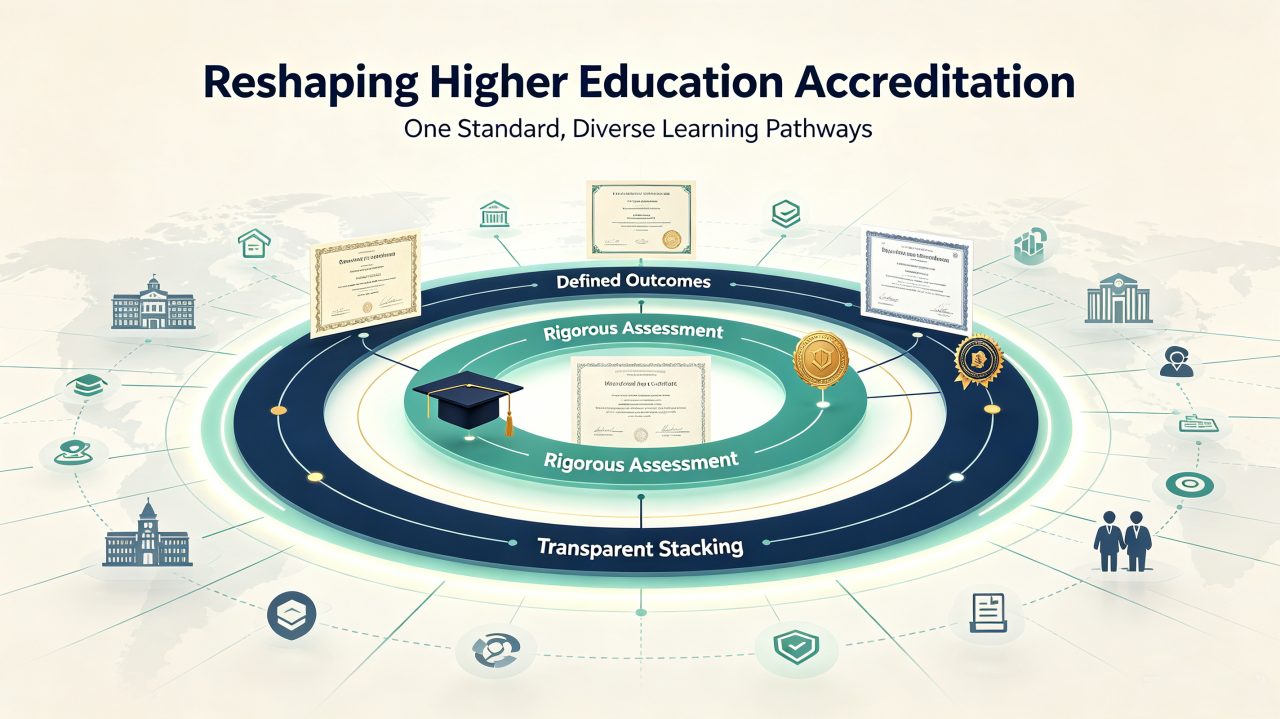
The framework establishes baseline quality assurance standards across three dimensions:
First, clearly defined learning outcomes. The greatest appeal of micro-credentials lies in their targeted nature, promising learners proficiency in specific skills or competencies. However, clear criteria are essential to bridge the gap between promise and delivery. The IAPUC-IQA Framework requires every micro-credential program to feature well-defined, measurable, and evaluable descriptions of learning outcomes. This serves not only as the starting point for instructional design but also as the cornerstone for subsequent assessment and recognition. As emphasized by UNESCO, micro-credentials should “describe learning outcomes using skill and competency taxonomies and align with qualification frameworks.”
Second, rigorous assessment mechanisms. The “micro” nature of micro-credentials should never justify compromised quality. The core function of Internal Quality Assurance (IQA) is to “monitor assessment practices, ensure that assessment decisions comply with national standards, and preserve the integrity and value of qualifications.” Extending this principle to micro-credentials and RPL, the IAPUC-IQA Framework mandates that every micro-credential award be based on robust assessment evidence, and every RPL recognition undergo a systematic, reviewable verification process. This aligns with the latest practices of international quality assurance bodies such as ABET, which launched its Recognition of Credentials service in 2025 to provide independent quality review for non-degree skill-based learning programs.
Third, transparent stacking rules. The true potential of micro-credentials lies in their stackability, enabling learners to combine multiple micro-credentials to build comprehensive qualifications incrementally. This potential can only be realized with fully transparent stacking rules. The IAPUC-IQA Framework requires clear definition of each micro-credential’s position, credit value, and progression pathways within the overall qualification system. Such transparency supports individual learners’ academic planning and facilitates recognition by employers and higher education institutions.
Division of Labor Between Macro Frameworks and Micro Practices
As the first United Nations global treaty on higher education, the UNESCO Global Convention on the Recognition of Higher Education Qualifications provides a grand institutional framework for cross-border qualification recognition. The Second Intergovernmental Meeting of State Parties, held in June 2025, placed micro-credentials at the center of its agenda, conducting in-depth discussions on “establishing clear recognition frameworks, ensuring quality assurance, enabling convertibility, and building trust in micro-credentials.”
However, the UNESCO Convention addresses only recognition — namely, how countries and institutions mutually recognize one another’s qualifications. It does not govern specific quality assurance operations. As Borhene Chakroun, a UNESCO official, noted, “The Global Convention serves as a framework for shared dialogue.” It provides principles, direction, and institutional foundations, while specific quality assurance practices — including program design assessment, project review, and prior learning recognition — fall to professional bodies to implement.
This is precisely the role of the IAPUC-IQA Framework. Rather than duplicating UNESCO’s work, it supplements detailed technical specifications and operational standards within the macro framework established by UNESCO. The relationship between the two can be analogized as follows: the UNESCO Convention constitutes the “constitution” for cross-border qualification mutual recognition, while the IAPUC-IQA Framework provides the corresponding “administrative regulations” and “operational manuals.”
Why This Matters
Quality assurance is never a decorative add-on to education; it is its lifeline.
In an era of proliferating micro-credentials, the absence of unified quality standards leaves learners unable to gauge the true value of micro-credentials, employers struggling to screen competent job candidates, and higher education institutions without credible criteria for accepting micro-credentials for admission or credit transfer. As one study warns, “Without a robust verification infrastructure, the proliferation of micro-credentials will create an unmanageable qualification ecosystem rife with fraudulent practices, where genuine achievements are indistinguishable from false claims.”
The IAPUC-IQA Framework serves as a quality assurance anchor for this rapidly expanding new frontier of education. By systematically applying the well-established quality assurance practices of traditional degree programs — clear learning outcomes, rigorous assessment, and transparent standards — to micro-credentials and RPL, it ensures that innovative new learning models do not become synonymous with low quality.
Admittedly, the framework is merely a starting point. The real challenge lies in implementation: encouraging thousands of global micro-credential providers to adopt unified standards, building mutual trust across national and regional education systems, and maintaining rigor while preserving flexibility. These are not simple problems to solve. Nevertheless, the IAPUC-IQA Framework charts a clear direction: quality assurance standards must remain consistent, regardless of whether learning takes place in classrooms or workplaces, and whether outcomes are documented as degrees or digital badges.
The future of education is being redefined. Micro-credentials and RPL do not subvert traditional education; instead, they complement and expand it. Yet to ensure such expansion does not dilute educational quality, frameworks like IAPUC-IQA are indispensable. They embrace innovation without compromising standards and champion change while safeguarding educational bottom lines. In an increasingly diverse learning landscape, this balance may prove to be the most vital element of future education development.