
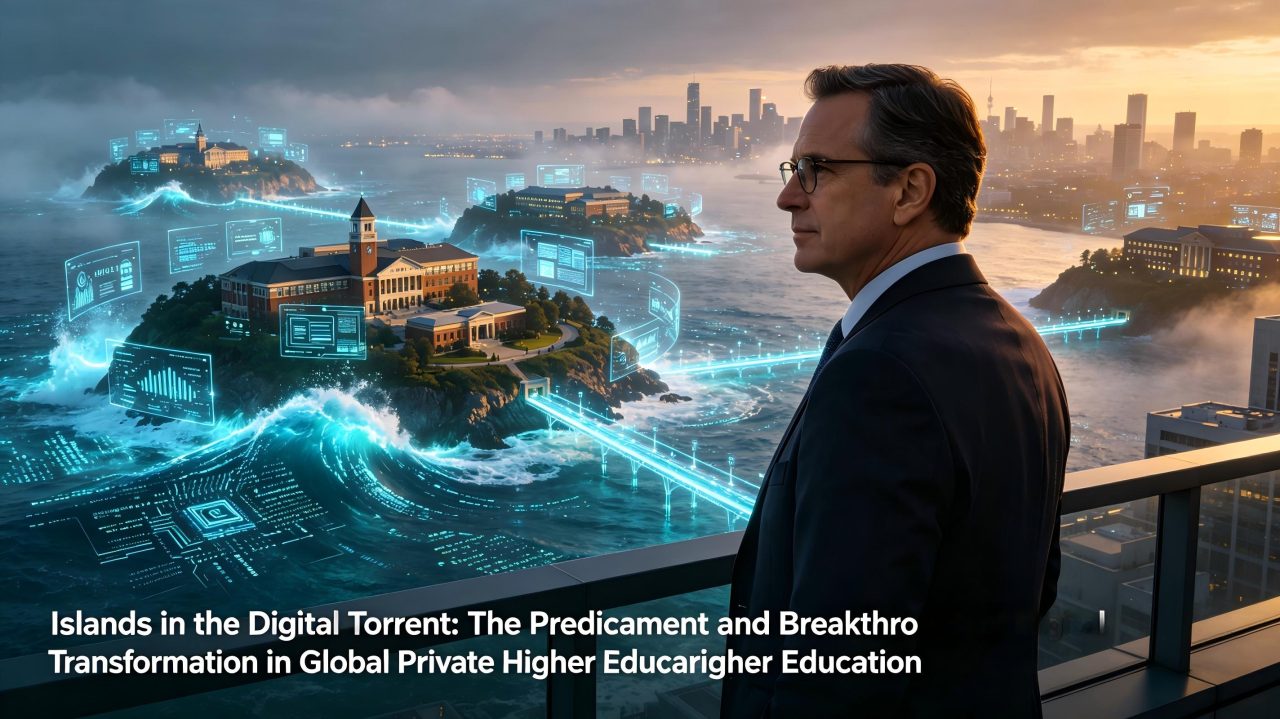
Islands in the Digital Torrent
–The Predicament and Breakthrough of Digital Transformation in Global Private Higher Education
Abstract
The tidal wave of artificial intelligence and digitalisation is reshaping the global higher education landscape at an unprecedented pace. In the midst of this profound transformation, private higher education institutions—the largest and fastest-growing segment of the global higher education system—are confronting an existential test of survival. This article offers a systematic, global analysis of the multi-dimensional predicaments confronting private universities in the digital age: from fundamental deficits in infrastructure and resources, to deep-seated constraints embedded in governance structures and institutional inertia; from systemic deficiencies in faculty digital literacy, to structural fractures in industry-education integration that manifest as “cooperation without convergence”; from the explosive collision between academic ethics and artificial intelligence, to the dual squeeze of declining traditional-age populations and intensifying market competition. The research reveals that the digital transformation predicament of private higher education is not an isolated technological issue, but a structural challenge shaped by the interplay of governance capacity, resource allocation, organisational culture, and external environmental pressures. On this basis, the article proposes a tripartite breakthrough pathway centred on “governance–capability–ecosystem”, arguing that private higher education institutions must transcend the shallow thinking of “technological instrumentalism” and, grounded in governance modernisation, capability building, and ecosystem restructuring, accomplish a strategic transformation from “passive adaptation” to “active leadership” in the digital torrent.
Keywords: Private Higher Education; Digital Transformation; Artificial Intelligence; Quality Assurance; Governance Modernisation
I. Introduction: The Test of Survival in the Digital Tide
The year 2025 finds global higher education at a historic crossroads. On one side, the explosive development of artificial intelligence is fundamentally reconfiguring the ways in which knowledge is produced, disseminated, and applied. On the other, a crisis of institutional survival among private higher education providers is accelerating worldwide. In 2024 alone, at least 16 non-profit private colleges in the United States announced closures, the vast majority of which were small-scale institutions heavily dependent on tuition revenues. Credit rating agencies and industry analysts have repeatedly warned that the risk of closure among regional private institutions continues to escalate.
This is no coincidence. The waves of artificial intelligence and digitalisation are not impacting all higher education institutions evenly—they are striking private institutions with the greatest force and at the deepest level. As one study has revealed, digital transformation is not merely a technological upgrade; it introduces new and complex governance challenges for private higher education institutions relating to institutional identity, financial sustainability, policy implementation, and stakeholder coordination.
The central question is this: Are the predicaments facing private universities in digital transformation primarily a matter of “technological insufficiency” at the operational level, or are they symptomatic of “systemic failure” at the institutional level? If the latter holds true, then a superficial response of “acquiring equipment and building platforms” will never fundamentally reverse the trajectory. This article seeks to answer the core proposition: In the face of the global digital wave, what structural predicaments has private higher education fallen into? What are the deeper roots of these predicaments? And how can systematic breakthroughs be identified and pursued?
II. The Multi-Dimensional Predicament: Structural Challenges in Private Higher Education Digital Transformation
2.1 Inherent Deficits in Infrastructure and Resources
The most immediate and visible predicament confronting private universities in digital transformation is the systemic scarcity of infrastructure and resources. A qualitative case study on AI integration among faculty at a private university identified three key barriers constituting the first threshold of digital transformation: (1) inadequate institutional technological infrastructure; (2) lack of systematic faculty training programmes; and (3) unresolved ethical dilemmas surrounding data privacy, algorithmic bias, and academic integrity.
This finding is far from isolated. In Vietnam, the level of digital transformation participation and achievement among private universities is significantly lower than that of prestigious and well-established public universities. Research indicates that the factors affecting digital transformation in non-public universities encompass government policy, human resources, technological infrastructure, and multiple other dimensions. Moreover, in Vietnamese private universities, the application of AI in online training remains fragmented, unsystematic, and constrained by a range of factors including technological infrastructure, human resources, financial capacity, governance mechanisms, and ethical-legal frameworks.
From a global perspective, the gap in digital infrastructure exhibits a pronounced “digital divide” characteristic. A systematic comparative assessment of Nigerian universities found that federal universities demonstrated the highest levels of AI integration, while private universities, despite showing strengths in curriculum innovation, lagged significantly in overall integration levels. This disparity is not accidental—it reflects the structural disadvantages of private institutions in resource acquisition, policy support, and institutional safeguards.
In the Chinese non-governmental higher education sector, similar issues are pronounced. Research reveals that private colleges are confronting four core problems: management’s prioritisation of “hardware over pedagogy”, outdated curriculum systems, weak faculty digital literacy, and a scarcity of practical resources. This tendency to emphasise “construction over application” has resulted in substantial digital investments failing to translate into genuine educational effectiveness.
2.2 Deep-Seated Constraints of Governance Structures and Institutional Inertia
If resource deficits are “visible predicaments”, then the deep constraints of governance structures are “invisible shackles”. Digital transformation is by no means a simple technological introduction—it is, in essence, a profound organisational transformation, inevitably touching upon power structures, decision-making processes, incentive mechanisms, and other core governance elements.
The governance predicaments of private higher education manifest in multiple dimensions. First, the non-professionalisation of governance structures is a widespread problem. Many private institutions still rely heavily on the personal authority of founders or family-style management, lacking the professionalisation, institutionalisation, and democratisation required for modern university governance. Such governance models, when confronted with the need for rapid decision-making, resource integration, and sustained investment demanded by digital transformation, often prove inadequate.
Second, the disconnect between strategic planning and implementation capacity is equally concerning. Digital transformation requires long-term strategic commitment and sustained resource allocation, but many private institutions, constrained by short-term financial pressures, often abandon their digital transformation efforts midway through the “investment phase”. As research has noted, private higher education institutions are divided into for-profit and non-profit categories, and digital transformation introduces starkly different governance challenges depending on institutional identity.
Furthermore, the resistance of institutional inertia cannot be overlooked. Higher education institutions are inherently conservative—their core business processes, academic cultures, and quality assurance systems have evolved over decades or even centuries, exhibiting strong path dependency. When disruptive technologies such as generative AI emerge, many private institutions respond not with active embrace but with passive defence. Observations from 2026 indicate that during the autumn 2025 semester, faculty reported a sharp increase in unauthorised use of AI; by January 2026, many faculty members had fallen into a state of exhaustion and reactive management. This passive-reactive management style precisely reflects the deep constraint of institutional inertia on change.
2.3 Systemic Deficits in Faculty Digital Literacy
Faculty constitute the “last mile” of educational digital transformation. No matter how advanced the technology or how sophisticated the platform, if faculty lack the capacity to translate technology into pedagogical effectiveness, digital transformation can only remain superficial. Yet this is precisely one of the weakest links in private higher education.
Multiple studies converge on the same conclusion: the systemic deficit in faculty digital literacy is the core bottleneck in private higher education digital transformation. In Lebanese private universities, the adoption of AI tools has been shaped by the interplay of economic pressures, infrastructural inequalities, and policy uncertainty. In Malaysian private universities, students’ use of ChatGPT has been found to involve seven core challenges: concerns about accuracy and reliability, technical access issues, difficulties in prompt engineering, discipline-specific comprehension limitations, language and communication barriers, academic integrity concerns, and emotional or cognitive impacts.
Even more concerning is the “digital anxiety” prevalent among faculty. Many instructors not only lack the skills to use AI tools but also lack a clear understanding of AI’s role in education. They worry that AI will replace teachers, that AI will facilitate academic misconduct, and that they themselves will be rendered obsolete by technology. If left unaddressed, such anxieties can transform into passive resistance to digital transformation.
A study of Polish higher education institutions found that technical universities and public universities demonstrated the highest levels of digital transformation readiness, while pedagogical, vocational, and arts institutions—particularly private ones—exhibited lower integration levels and limited technological access. This finding reveals a sobering reality: not all higher education institutions are equal in the face of digitalisation—those with the fewest resources, the weakest capacities, and the shortest histories, namely private institutions, are precisely those confronting the most severe digital challenges.
2.4 The Predicament of “Cooperation without Convergence” in Industry-Education Integration
Industry-education integration is widely regarded as the core pathway for applied talent cultivation and a key competitive advantage distinguishing private institutions from research-oriented public universities. However, in the context of digital transformation, industry-education integration itself has fallen into profound difficulties.
Research indicates that industry-education integration platforms in private colleges are encountering three practical obstructions: information silos restricting the effective circulation of digital resources; school-enterprise collaboration remaining largely at the level of signed agreements without substantive implementation; and a discernible generational gap between practical teaching and industry frontiers. This predicament of “cooperation without convergence” renders industry-education integration a mere formality, failing to achieve the precise alignment of talent cultivation with industrial demand.
At a deeper level, the digital transformation of industry-education integration itself remains an unresolved problem. Enterprises require graduates with digital literacy and AI application capabilities, yet many private institutions continue to deliver curricula dominated by traditional theoretical instruction, which deviates significantly from actual industry needs. As research has shown, the three major challenges faced by private colleges in industry-education integration—resource development bottlenecks, severe disconnection between education and industry, and weakening school-enterprise collaboration—are seriously compromising the quality of talent cultivation.
The consequences of this disconnect are devastating: graduates lack both the traditional “solid foundation” and the digital-age “cutting-edge skills”, finding themselves trapped in an awkward position of being “overqualified for lower positions and underqualified for higher ones” in the job market. The ensuing decline in employment rates further exacerbates enrolment difficulties and financial pressures, creating a vicious cycle.
2.5 The Collision Between Academic Ethics and Artificial Intelligence
The impact of artificial intelligence on higher education is most profound and most intractable in its fundamental challenge to academic ethics and the very mode of knowledge production. This is not merely a technological issue but a civilisational one.
In private institutions, the ethical dilemmas posed by AI are particularly acute. A qualitative study of a private university in the Philippines revealed that both students and faculty, when confronting the relationship between AI and educational equity, generally expressed deep concerns about moral dilemmas and potential misuse. The study recommended the creation of ethical AI usage workshops to help students and faculty uphold academic integrity. This reflects the fact that private institutions remain in a reactive, “fire-fighting” phase in addressing AI ethical challenges.
The ethical challenges posed by AI are multi-layered. At the most superficial level is the surge in academic misconduct—students using AI to generate essays and complete assignments, with faculty struggling to distinguish authenticity. At a deeper level lies the fundamental transformation of knowledge production—when AI can generate ostensibly plausible academic texts, the very meaning of “authorship” is being eroded. At the deepest level is the alienation of educational objectives—if knowledge acquisition and textual production can both be accomplished by AI, what then is the core value of university education?
As a case study of a private college in Nepal illustrates, the rapid proliferation of generative AI is forcing universities worldwide to redefine learning, authorship, and academic integrity. This process of redefinition is fraught with pain and uncertainty, and for resource-constrained, governance-weak private institutions, the distress of this transformation is particularly acute.
2.6 The Dual Squeeze of Declining Traditional-Age Populations and Intensified Market Competition
If the above predicaments are more “endogenous”, then declining traditional-age populations and intensifying market competition constitute exogenous pressures of lethal force. The convergence of these two forces is pushing many private institutions to the brink of survival.
In the United States, the decline in college-age population is irreversible. Projections indicate that between 2026 and 2041, the number of 18-year-olds in the United States will decrease by 13%. Between 2010 and 2021, total US university enrolment declined by 15%. Researchers have modelled that a 15% enrolment decline would double the annual rate of college closures. The most vulnerable are precisely private institutions—particularly those located in rural areas with shrinking populations and heavily dependent on tuition revenues.
This trend is not unique to the United States. In India, the All India Council for Technical Education (AICTE) approved the closure of 27 private colleges in the 2024–2025 academic year. In Canada, the closure of a private college in British Columbia left approximately 300 students stranded. Globally, the wave of private higher education closures is accelerating.
Simultaneously, the rise of online education is fundamentally restructuring the higher education market. A study of Brazil’s private online higher education sector showed that without online courses, total enrolment would be 14% lower, while face-to-face enrolment would be 33% higher. This implies that while online education has expanded the overall market, it has also intensified the survival pressures on traditional face-to-face private institutions—students have more choices, but traditional private institutions find it difficult to transform rapidly.
Digital transformation was supposed to be the “antidote” for private institutions facing demographic decline, yet the reality is that digital transformation itself requires substantial investment, while population decline is eroding the revenue base of private institutions. This double bind of “needing to transform while struggling to survive” constitutes the deepest structural contradiction confronting private higher education.
III. The Logic of Transformation: Why Change Is Inevitable
Confronted with the multi-layered predicaments outlined above, can private institutions choose a strategy of “standing still”? The answer is unequivocally no. Standing still means a slow death.
3.1 Digitalisation Is Not an Option but a Condition of Survival
The 2025 Higher Education Innovation Index study revealed that 49% of campuses are accelerating technology investment, but 44% of institutions list “implementation” as their primary challenge. In other words, nearly half of all institutions already recognise the urgency of digital transformation and have begun to act, yet almost as many are encountering formidable obstacles in implementation.
Even more noteworthy is the emerging “winner-take-all” effect of digital transformation. Those institutions that complete their digital transformation first will gain competitive advantages across enrolment, teaching, research, and employment outcomes; those that lag behind will be progressively marginalised. As one study has warned, disruptive AI technologies, combined with growing societal resistance to the “gatekeeper” role of universities, are bringing an end to the “golden age” of higher education. The future of higher education will be segmented—a small number of prestigious private institutions will maintain their elite status, while the majority of ordinary private institutions will face elimination.
3.2 AI Is Redefining the Standards of “Educational Quality”
Traditionally, educational quality has been measured primarily by faculty qualifications, curriculum design, and physical facilities. But in the age of AI, these standards are being fundamentally redefined.
AI-enabled education systems may undermine judgement, obscure incentives, and erode learning outcomes unless ethical reasoning is embedded in their design. This means that future educational quality will no longer depend solely on “what is taught” and “who teaches it”, but also on “how technology is leveraged to enhance learning” and “how technology is ensured to serve educational goals within an ethical framework”.
For private institutions, this presents both a challenge and an opportunity. The flexibility of private institutions potentially enables them to embrace new technologies and experiment with new pedagogical models more quickly than public institutions. However, the prerequisite is that they possess sufficient resources, capabilities, and strategic vision.
3.3 Paradigm Shifts in Student Expectations and Market Demands
Students in the digital age have undergone fundamental changes in their learning styles, information-acquisition habits, and career expectations. They desire personalised learning pathways, flexible schedules and modes of study, and skills that can be directly applied in the workplace. Traditional “one-size-fits-all” classroom instruction and standardised examinations are increasingly failing to meet the needs of this generation of students.
Simultaneously, labour market demands for “digital literacy” are rising sharply. Regardless of industry, professionals with AI application capabilities, data literacy, and digital thinking are highly sought after. Private institutions that fail to cultivate these competencies will soon be abandoned by both students and employers.
As an African private education network demonstrated in its 2025 impact report, AI is helping students reimagine the learning experience across multiple dimensions, from personalised learning to intelligent academic support, assessment, and career guidance. This “student-centred” digital transformation is becoming the key to winning the future for private institutions.
IV. Pathways to Breakthrough: Finding Life in Adversity
4.1 Governance Modernisation: From “Rule by Person” to “Rule by System”
The foundation of digital transformation lies not in technology but in governance. If governance structures are inadequate, even the most advanced technology will fail to deliver its potential.
Governance modernisation in private institutions should proceed along several fronts. First, establish professionalised decision-making mechanisms. Digital transformation involves numerous professional judgements—technology selection, resource allocation, risk assessment—all of which require specialised knowledge and systematic decision-making processes, rather than reliance on personal experience or intuition.
Second, build sustainable investment mechanisms. Digital transformation requires sustained financial commitment, not a “one-off project”. Private institutions should establish dedicated digital development funds, ensuring the sustainability of digital investments through diversified revenue streams (tuition income, philanthropic donations, industry partnerships, government programmes, etc.).
Third, improve stakeholder participation mechanisms. The success of digital transformation depends on the understanding and support of faculty, students, alumni, employers, and other stakeholders. Private institutions should establish regular communication and participation mechanisms to ensure that all parties have a sense of ownership and benefit from the transformation process.
4.2 Capability Building: From “Technology Introduction” to “Human Transformation”
The greatest challenge of digital transformation lies not in the technology itself but in the “transformation of people”. The digital literacy of faculty and administrators is the critical variable determining the success or failure of transformation.
Systematic faculty training is an urgent priority. Training should not remain at the operational level of “how to use tools” but should extend to the methodological level of “how to integrate technology into pedagogy” and the value level of “how to address the ethical challenges posed by AI”. As research has recommended, creating ethical AI usage workshops is an effective means of helping students and faculty uphold academic integrity.
Reform of incentive mechanisms is equally indispensable. In many private institutions, faculty lack the motivation to adopt new technologies because existing evaluation systems do not recognise contributions to digital teaching. Private institutions should incorporate digital teaching competencies into faculty evaluation and promotion systems, providing tangible rewards for those who actively embrace digital transformation.
Cultivation of student digital literacy is also critical. In the age of AI, students need not only to learn how to use AI tools but also to learn how to critically evaluate AI-generated content, understand the limitations of AI, and maintain independent thinking and creativity in the presence of AI assistance. These competencies will be the core competitiveness of future talent.
4.3 Ecosystem Restructuring: From “Going It Alone” to “Collaborative Symbiosis”
Private institutions have limited resources and capabilities; a go-it-alone approach to digital transformation is ultimately unsustainable. Building an open, collaborative digital transformation ecosystem is the key to breaking through resource constraints.
Inter-institutional collaboration is a viable pathway. Private institutions can form consortia or networks to share digital infrastructure, course resources, and faculty training programmes, reducing the cost of transformation for individual institutions. The UNESCO-ICHEI “IIOE Higher Education Digital Pioneer Award” in 2025 attracted 95 applications from 29 countries, including 48 higher education institutions and 13 corporate partners. This model of international cooperation offers valuable lessons for private institutions.
University-industry partnerships constitute another important pathway. Technology companies possess the technical capabilities and resources that private institutions lack, while private institutions offer the talent cultivation contexts and research capabilities that companies desire. Collaboration between the two can achieve mutual complementarity. As research has noted, AI adoption requires institution-specific strategies, prioritising faculty development, infrastructure investment, and sustainable funding—areas in which industry partnerships can provide robust support.
University-government cooperation is equally important. Although private institutions do not depend on government funding to the same extent as public institutions, the role of government in policy guidance, standard setting, and project funding remains significant. Private institutions should actively engage in policy dialogue to seek greater policy support and resource allocation for digital transformation.
4.4 Differentiated Positioning: From “Follower” to “Leader”
Private institutions should not blindly imitate the digital transformation pathways of public institutions. Instead, they should leverage their own flexibility and innovative spirit to chart a differentiated course of transformation.
Focusing on niche areas is central to differentiated positioning. Private institutions cannot compete with resource-rich public institutions across all fields. They should concentrate their resources on areas where they hold comparative advantages—such as applied talent cultivation, vocational education, online education, and industry-specific partnerships—to achieve breakthroughs. As research has revealed, private universities can demonstrate their strongest performance in curriculum innovation—precisely an area they can cultivate.
Embracing online education and blended learning is another differentiated pathway. Studies have shown that online growth can save struggling universities. For private institutions facing enrolment decline, expanding into the online education market not only broadens the recruitment pool but also reduces operating costs and improves resource efficiency.
Deepening industry-education integration is a natural advantage for private institutions. Compared with public institutions, private institutions are institutionally more flexible and more capable of establishing deep collaborative relationships with industry. Private institutions should advance industry-education integration from the “agreement level” to the “operational level”, bringing real enterprise needs, real projects, and real-world scenarios into the teaching process, allowing students to acquire genuine professional competencies through “learning by doing”.
V. Conclusion: Reshaping the Future of Private Higher Education in the Digital Torrent
Private higher education stands at a historic inflection point. The tidal wave of digital transformation is both a challenge and an opportunity; both a test of survival and a moment of rebirth.
The analysis in this article has demonstrated that the predicaments facing private institutions in digital transformation are multi-dimensional and structural—encompassing “inherent deficits” at the resource level, “deep-seated constraints” at the governance level, “systemic deficiencies” at the capability level, “structural fractures” at the ecosystem level, “value conflicts” at the ethical level, and “survival pressures” at the market level. These predicaments are intertwined and mutually reinforcing, forming a “vicious cycle of predicaments” that is difficult to break.
Yet predicaments are not dead ends. The tripartite breakthrough pathway of “governance–capability–ecosystem” proposed in this article demonstrates that private institutions can indeed find their own way out of digital transformation. Governance modernisation provides the institutional foundation for transformation; capability building supplies the human capital; ecosystem restructuring offers the resource base—the three are mutually reinforcing, together constituting a systematic solution for private higher education digital transformation.
Ultimately, the digital transformation of private higher education is not a “technological upgrade” but an “organisational rebirth”. It requires private institutions to transcend the shallow thinking of “technological instrumentalism”, fundamentally re-examining their missions, strategies, governance, and culture. It demands that private institutions shift from “passive adaptation” to “active leadership”, from “imitative followership” to “differentiated innovation”, and from “going it alone” to “collaborative symbiosis”.
In the digital torrent, those private institutions that can complete this profound transformation will not merely survive—they will redefine their position and value within the higher education system in this once-in-a-century upheaval. Those that cannot complete the transformation will be mercilessly eliminated by the tide of history.
History does not wait for the hesitant. The digital transformation of private higher education cannot afford delay.
References
- Artificial Intelligence in Higher Education: A Case Study of Faculty Teaching Methodologies at a Private University (2025)
- New Research Reveals Higher Education’s Digital Transformation Progress Amid Budget Pressures and Enrollment Challenges, Higher Ed Innovation Index 2025
- Digital transformation in non-public universities: empirical evidence from Hanoi City, Vietnam (2026)
- Institutional Structures, Digital Inequality, and AI Integration in Higher Education (2026)
- Ứng dụng trí tuệ nhân tạo trong đào tạo trực tuyến tại các trường đại học ngoài công lập ở Việt Nam: Thực trạng, thách thức và giải pháp chiến lược (2026)
- Signals of Distress: A Global Wave of University and College Closures (2025)
- The AI pedagogy dilemma: when innovation meets integrity at Kathmandu College (2026)
- The Governance Path of Private Higher Education in Guangdong Province Under the Background of the Digital Economy (2025)
- Strategies for the Construction of Industry-Education Integration Platforms in Private Colleges and Universities Under the Background of Digital Empowerment
- Design and Implementation Strategies for the Digital Transformation of Accounting Majors in Private Colleges and Universities (2026)
- Research on the Path of AI Empowering Applied Talent Cultivation in Private Colleges and Universities (2025)
- Value, Challenges and Paths of Generative Artificial Intelligence Empowering Blended Teaching in Private Colleges and Universities (2025)
- The Influence of AI on Business Education: Comparing Learning Experiences in Private and State Universities (2025)
- Academic Integrity in the Age of AI: Exploring on the Educational Experiences for Students and Teachers in a Private University in the Philippines
- Online growth can save struggling US universities (2025)