


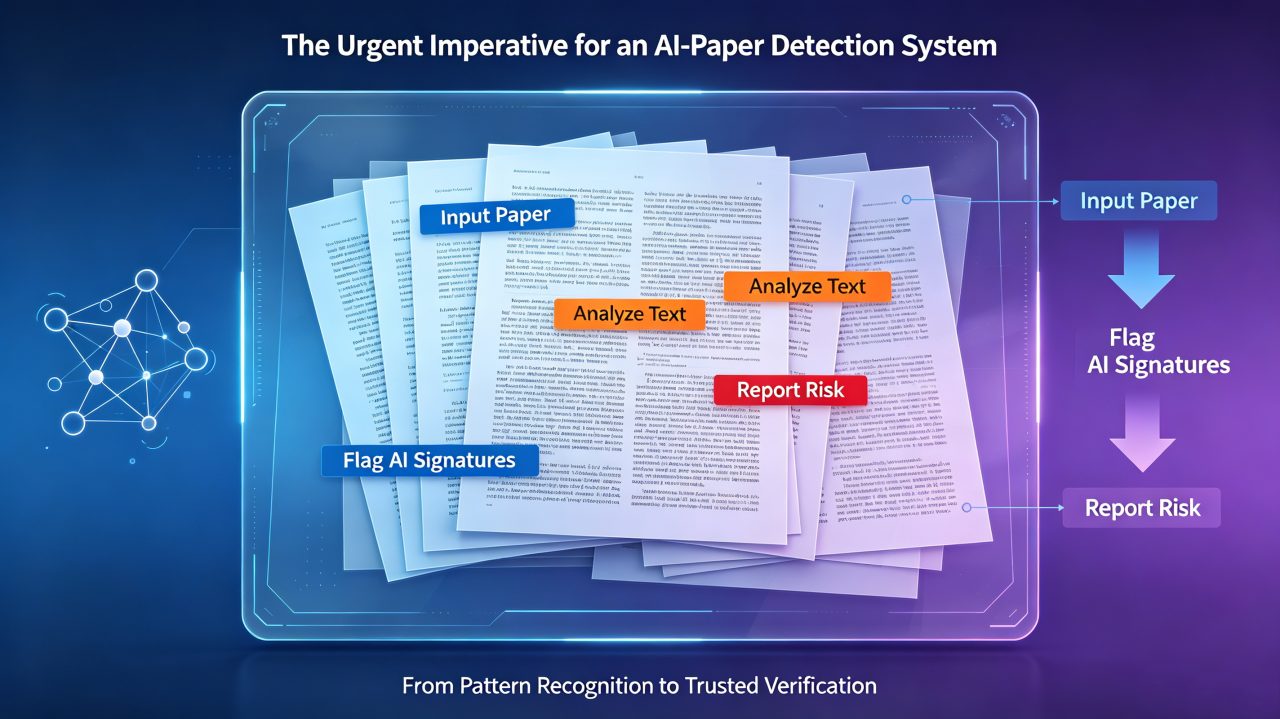
The Urgent Imperative for an AI-Paper Detection System
An IAPUC Editorial
Originally published in the IAPUC Quality Assurance Monitor, July 2026
- The Scale of the Crisis
The integration of generative artificial intelligence into academic writing has accelerated at a pace that has outpaced the capacity of institutions to respond. What began as a novel tool for researchers has evolved into a systemic threat to the very foundations of scholarly integrity. The data are unequivocal and deeply concerning.
A comprehensive study conducted by the American Association for Cancer Research (AACR), analysing 7,177 manuscripts submitted to its ten journals between January and June 2025, found that 36% of article abstracts contained AI-generated content. Yet when authors were asked in an automatic step of the submission process to disclose any use of AI, only 9% acknowledged doing so. This fourfold disparity between actual usage and honest disclosure reveals a profound crisis of transparency that strikes at the heart of academic integrity. The gap demonstrates that reliance on voluntary disclosure is entirely insufficient.
This phenomenon is not confined to a single publisher or discipline. A study published in Nature Human Behaviour, analysing over one million scientific papers, found that up to 22.5% of computer science abstracts showed signs of modification by large language models. Nanyang Technological University’s analysis of thousands of biomedical research articles revealed that 12.4% of 2025 papers contained at least one passage classified as AI-written. In higher education dissertations, AI-generated text surged from 2.3% in 2020 to 20.4% in 2025, a statistically significant increase with a correlation coefficient of ρ = 0.91 (p < 0.001).
Perhaps most alarmingly, the problem extends beyond authorship into peer review itself. At the International Conference on Learning Representations (ICLR) 2026, over 15,000 review reports were found to be entirely AI-generated. Approximately 21% of review comments were determined to be fully automated. The peer-review process—the cornerstone of academic quality control—has been systematically undermined by the very technology it was meant to evaluate.
- The Ethical and Moral Dimensions
The use of AI to generate academic papers without transparent disclosure constitutes a fundamental breach of scholarly ethics. It violates several core principles that underpin the academic enterprise.
Authorship and Accountability. The Committee on Publication Ethics (COPE) maintains that AI tools cannot be listed as authors of academic papers because they are unable to take responsibility for the submitted work. Authorship is not merely a matter of textual production; it entails accountability for the accuracy, integrity, and intellectual contribution of the work. When a paper is substantially generated by AI, the human author cannot genuinely claim authorship in any meaningful ethical sense.
Transparency and Honesty. The deliberate concealment of AI involvement in paper writing constitutes deception. It misrepresents the nature and extent of human intellectual labour, undermining the trust that is essential to scholarly communication. As one university policy articulates, “Submitting text that has been generated by AI is not writing; it is plagiarism”. When authors obscure the role of AI, they deprive readers, editors, and reviewers of the information necessary to evaluate the work’s credibility.
Intellectual Integrity. Academic writing is not merely a mechanical act of arranging words; it is an expression of critical thinking, analytical rigour, and original insight. The wholesale delegation of these intellectual processes to AI systems represents an abdication of scholarly responsibility. As research-led organisations have warned, “AI-generated text often lacks a compelling narrative or analytical depth,” and early-career researchers must build strong scientific writing skills that AI cannot replicate.
The Erosion of Human Agency. UNESCO has emphasised that the challenge posed by generative AI is structural rather than merely ethical: “the observability of authorship has collapsed, and enforcement regimes built on that observability cannot be restored by policy alone”. This collapse of observability represents a profound threat to human agency in the creation of knowledge.
III. The Assault on Academic Fairness
The unchecked use of AI in academic writing creates a deeply inequitable landscape that systematically disadvantages honest scholars and undermines the meritocratic ideals of academia.
The Unfair Advantage. Authors who use AI to generate papers without disclosure gain a significant and illegitimate advantage over those who invest the time and intellectual labour to produce original work. They can produce manuscripts more quickly, with less effort, and in greater volume—all while evading detection. This creates a perverse incentive structure that rewards technological cunning over intellectual rigour.
The Devaluation of Genuine Scholarship. When fraudulent or AI-generated papers flood the academic marketplace, they devalue the legitimate accomplishments of scholars who have earned their credentials through genuine effort. As one commentator observed, “AI has already lowered the threshold for misconduct”. The proliferation of AI-generated content makes it increasingly difficult for employers, credential evaluators, and the public to distinguish between authentic scholarship and algorithmic output.
Disproportionate Impact on Non-Native English Speakers. The ethical dimensions of AI detection are further complicated by the phenomenon of false positives. Research has demonstrated that AI detection tools disproportionately flag the writing of non-native English speakers as AI-generated. ChatGPT-polished writing “boosts the risk of human-authored manuscripts being miscredited as AI-generated”. This creates a paradoxical situation in which scholars who use AI to improve their English-language writing—often as a legitimate aid—face greater scrutiny and risk of false accusation than native speakers who may use the same tools more extensively.
The Arms Race Mentality. The current dynamic has spawned a counterproductive arms race between generators and detectors. A new industry has emerged around “AI-checking—AI-reduction—re-checking” cycles, with tools designed to evade detection creating an endless loop of technological escalation. This distracts from the fundamental purpose of academic inquiry and consumes resources that could be devoted to genuine research.
- The Damages: A Multi-Faceted Assault on Scholarship
Damage to Research Integrity
AI-generated papers often contain fabricated references, invented data, and plausible-sounding but entirely false information—a phenomenon known as “AI hallucination”. A 2025 study found that 79.2% of students and 77.1% of faculty had encountered AI-generated content containing errors disguised as plausible information. When such content enters the scholarly record, it corrupts the knowledge base upon which future research depends.
Retractions attributable to undisclosed AI use are rising sharply. In 2023 alone, 667 AI-related retractions were recorded. A Springer Nature journal began retracting scores of commentaries and letters after being inundated with AI-generated manuscripts. Each retraction represents not merely an embarrassment but a failure of the quality-assurance systems that are supposed to safeguard scholarly integrity.
Damage to the Peer-Review System
The peer-review system, which has served as the bedrock of academic quality control for centuries, is now under existential threat. When reviewers use AI to generate their evaluations without disclosure, they violate the confidentiality of the review process and betray the trust placed in them by authors and editors. The ICLR case, in which over 15,000 review reports were AI-generated, demonstrates that the problem has reached epidemic proportions. As one scientist lamented, “you spent sleepless nights writing your paper, and the reviewer spent one second having ChatGPT generate a bunch of ‘correct nonsense’”.
Damage to Institutional Reputation
Universities and research institutions that fail to address the AI-paper crisis risk severe reputational damage. The proliferation of AI-generated theses and dissertations undermines the credibility of academic credentials. Employers and graduate programmes increasingly view degrees from institutions with inadequate quality assurance with suspicion, harming the prospects of all graduates—including those who have earned their qualifications legitimately.
Damage to Public Trust
Perhaps the most profound damage is to public trust in science and scholarship. In an era already characterised by scepticism toward expertise, the revelation that significant portions of the academic literature may be AI-generated further erodes confidence in the reliability of scholarly knowledge. When the public cannot distinguish between genuine research and algorithmic output, the entire edifice of academic authority is weakened.
- The Limitations of Current Approaches
Existing mechanisms for addressing the AI-paper crisis are manifestly inadequate.
Voluntary Disclosure Has Failed. The AACR study’s finding that only 9% of authors using AI disclosed that fact, despite 36% of abstracts containing AI-generated text, demonstrates that self-reporting is entirely insufficient.
Detection Tools Are Imperfect. Current AI detection technologies suffer from significant limitations. Turnitin’s AI detection tool has acknowledged a sentence-level false-positive rate of 4%. Studies consistently show these tools produce both false positives—identifying human-written text as AI-generated—and false negatives. As one analysis concluded, “the unreliability of genAI detection tools and the impact of false accusations makes them unsuitable for high-stakes situations like academic misconduct investigations”. Furthermore, AI-generated fake papers often register only 2–5% similarity in iThenticate, compared with 10–15% for genuine manuscripts, suggesting they may be deliberately designed to evade detection.
Institutional Policies Are Inconsistent and Ineffective. A 2025 UNESCO survey of 400 higher-education respondents across 90 countries found that only 19% reported that their institution had a formal AI policy. While 67.8% of students and 60.4% of faculty confirmed their institutions had explicit AI usage policies, 42% of both groups deemed existing guidelines only “partially effective,” and more than 11% criticised policies as outdated. The patchwork of institutional responses creates confusion and enables evasion.
The Arms Race Dynamic. As detection tools improve, so do evasion techniques. Turnitin has been forced to develop “AI bypasser detection” to identify content that has been modified specifically to evade detection. This technological escalation is unsustainable and diverts resources from the core mission of education and research.
- A Constructive Path Forward: Building the AI-Paper Detection System
The establishment of a robust, comprehensive AI-paper detection system is not merely desirable—it is an urgent necessity. IAPUC proposes the following framework for such a system, drawing on the best available evidence and the collective wisdom of the global quality-assurance community.
- Mandatory AI Disclosure with Verification
Voluntary disclosure has failed. Institutions must move to mandatory AI-use declarations, verified through automated detection systems. This is not a matter of trust but of accountability. The AACR study demonstrates that “disclosures on their own have virtually no value without some means of determining their accuracy”. Submission systems should require authors to attest to the extent of AI use at the point of submission, with false declarations subject to sanctions.
- Multi-Layered Detection Architecture
No single detection tool is sufficient. Institutions should employ a multi-layered approach combining:
- Statistical analysis of linguistic patterns and vocabulary distributions
- Cross-referencing against known AI-generated text databases
- Citation and reference verification to detect fabricated sources
- Human expert review of flagged papers, with detection tools used as supporting evidence rather than as definitive judgments
As Turnitin itself advises, detection results “should always be reviewed by subject experts and used as supporting evidence, not as a replacement for academic judgement”.
- Centralised Reporting and Data Sharing
The fight against AI-generated papers requires collective action. A centralised database of known AI-generated papers, detection patterns, and evasion techniques would enable institutions to share intelligence and coordinate responses. This could be administered by an international body such as IAPUC, working in partnership with COPE, INQAAHE, and UNESCO.
- Standardised Institutional Policies
The current fragmentation of institutional policies creates confusion and enables evasion. A standardised framework for AI use in academic writing—developed through international consensus and adapted to local contexts—would provide clarity for students, faculty, and researchers. Such a framework should address:
- Permissible and prohibited uses of AI in academic writing
- Disclosure requirements and formats
- Sanctions for non-disclosure and misuse
- Appeals processes to protect against false accusations
- Education and Capacity Building
Detection systems are necessary but insufficient. Institutions must invest in education about the ethical use of AI in academic writing. As the AACR study’s lead researcher noted, “the challenge is to leverage new tools while ensuring scientific integrity and transparency. Failure to do so risks losing trust in the entire scientific publication system”. Training programmes should address:
- The ethical principles underlying academic integrity
- The proper use of AI as a tool rather than as a substitute for intellectual labour
- The risks and consequences of AI misuse
- The skills necessary to evaluate AI-generated content critically
- Investment in Detection Technology
Research and development of more accurate, fairer AI-detection tools must be prioritised. Current tools exhibit significant biases against non-native English speakers and fail to keep pace with evolving evasion techniques. Public and private investment in next-generation detection technologies is essential to maintain the integrity of the scholarly record.
- International Cooperation and Standard Setting
The AI-paper crisis is a global problem requiring a global response. International organisations—including UNESCO, COPE, INQAAHE, and IAPUC—must work together to develop common standards for AI detection, disclosure, and enforcement. The 2025 UNESCO survey’s finding that only 19% of institutions have formal AI policies underscores the need for coordinated international action.
- Protection Against False Accusations
Any detection system must incorporate robust safeguards against false accusations. As Roy Perlis, Editor-in-Chief of JAMA+AI, warned, “There is a real risk that we plug these things into our [editorial] pipelines and treat their outputs as if they are infallible”. Institutions must establish clear appeals processes and ensure that detection results are reviewed by human experts before any adverse action is taken.
VII. The IAPUC Commitment
IAPUC is committed to leading the global effort to address the AI-paper crisis. Our Internal Quality Assurance (IQA) framework—built on the three pillars of mission-driven purpose, outcomes-based assessment, and performance excellence—provides the foundation for a comprehensive approach to academic integrity in the age of AI.
We are actively developing:
- IQA standards for AI use in academic writing, research, and publication
- Detection and verification protocols for IQA-accredited institutions
- Training programmes for peer reviewers and quality-assurance professionals
- International partnerships with COPE, INQAAHE, UNESCO, and other quality-assurance bodies
- A centralised reporting mechanism for suspected AI-generated papers
We call upon all stakeholders in the global academic community—universities, publishers, quality-assurance agencies, and individual scholars—to join us in this urgent endeavour. The integrity of the scholarly record, the fairness of academic evaluation, and the trust of the public depend upon our collective action.
VIII. Conclusion
The evidence is overwhelming and the stakes could not be higher. Generative AI has transformed academic writing at a speed and scale that has outstripped the capacity of existing quality-assurance mechanisms. The gap between actual AI use and honest disclosure—36% versus 9% in the AACR study—reveals a crisis of integrity that threatens to undermine the entire scholarly enterprise.
The establishment of a robust AI-paper detection system is not merely a technical challenge; it is a moral imperative. Without such a system, we risk the devaluation of genuine scholarship, the unfair disadvantaging of honest researchers, the corruption of the peer-review process, and the erosion of public trust in academic knowledge.
The time for half-measures has passed. The academic community must act decisively and collectively to build the detection infrastructure, develop the standards, and invest in the education necessary to preserve the integrity of scholarly communication. The alternative—a future in which the distinction between human insight and algorithmic output becomes indistinguishable—is not a future we can accept.
The IAPUC Editorial Team is committed to advancing quality assurance in private higher education worldwide. For inquiries about IAPUC’s AI-paper detection initiatives or to contribute to this critical effort, please contact secretariat@iapuc.org.